Art, Art activities, Craft, DIY, Make, Create, & Share!

DIY Shell Trinket Dishes

Turn some of those beach treasures into a lovely trinket dish! These make great personalized gifts too!

What you need:

  • Clean shells – larger, smoother shells are easiest to start with!
  • Mod Podge – I used gloss
  • Paint brushes
  • Decorative tissue papers, or thin papers (like origami paper).
  • Scissors
  • Acrylic paints in desired colors
  • Metallic paints – I used Lumiere by Jacquard

Step one: Gather and clean your shells – ones that have larger, flat/smooth insides will be easiest to start with!

Step two: Find printed tissue papers, pieces of maps, origami papers, or any other thin paper to decoupage your shells with

Step three: If using tissue papers to decoupage your shell with, first paint the inside surface of your shell with acrylic paint. I used white, as my tissue paper was white with printed blue designs – this way the white parts of the tissue looks like it disappears in the back ground of my shell. You may need to apply more than one layer of paint to cover your shell with – if this is the case, let your paint dry between layers.

Step four: Cut your papers for your shells – if using tissue papers that match with the background of your shell, you don’t have to be too careful in cutting out the design precisely. If using papers that will completely cover the inside of your shell, cut it quite a bit larger than your shell!

Step five: If using tissue paper – Add Mod Podge to the inside of your shell and place your tissue paper on top

Step six: If using other papers – brush a layer of mod podge in your shell and on the back of your paper, then place in your shell

Step seven: Gently brush a layer of mod podge on top of your tissue paper or if you’re using paper follow the steps below!

Step eight: If using paper, vs. tissue paper, use your fingers to firmly press your paper into your shell…..start from the center of your shell and work out

Step nine: Use a firm brush to add a layer of mod podge on top of your paper – use the brush to help push and smooth out the paper on the shell surface! Just be careful not to tear your paper as it can become fragile!

Step ten: Let your mod podge dry and trim off any extra paper – you may also need to add in extra mod podge around the cut edges if you have some areas that are not quite stuck! Don’t worry if your cut edge is not perfect – as long as it’s glued down well, the cut edge will get covered with the metallic paints!

Step eleven: Use your metallic paints to create a painted outline on your shells!

Have fun creating these simple trinket dishes! You could also drill a hole and make them an ornament or add other elements in them like other shells, personal photos, sea glass, etc.!

Art, Art activities, Drawing, Make, Create, & Share!

Quick tip: DIY transfer paper

Ever want to transfer a drawing or printed image to another piece of paper or copy it multiple times? I typically draw my outlines on just a plain piece of printer paper and transfer onto my final drawing paper with this method….you can easily and quickly transfer your drawings this way and the transfer is also erasable!

All you need is your drawing or image you’d like to transfer (these work best on thin papers), a graphite pencil & and the canvas, paper, or surface you want to transfer your drawing to! You may also prefer to have some tape handy to help hold your paper in place.

Gather all your supplies!

Turn over the drawing, or outline you’d like transfer. Using the side of your pencil tip, shade in the back of your outline. You only have to shade where the lines you’ll be tracing on the flip side are – you can check this by flipping your paper back over and holding it up to the light (looking through your paper) to see if you’ve missed any areas with the shading.

Once you have the backside shaded in, line up your outline on the surface you’d like to transfer it to. Use tape to hold your paper in place while you trace.

Pressing firmly, trace your outline with a pencil. You can take a peek to make sure the transfer is working or to check and see if you’ve missed any lines! You can also trace your outline with a colored pencil to clearly indicate where you’ve already traced!

Once you’ve traced your outline, carefully remove the tape and your paper to reveal your copy! Since this is a graphite transfer you can also erase or lighten any lines before using your transfer in a finished project! 🙂

This is also a great method to transfer the sand dollar template for this acrylic painting!

Art, Art activities, DIY, Drawing, Make, Create, & Share!

One Point Perspective Words!

One point perspective lettering is a fun and easy way to get started with perspective drawing and an element you can apply to other works of art! Check out the instructions and video below to create your own one point perspective words!

What is perspective drawing? When we look at something we see things a little differently then how they actually are – for example, we know that the edges of a road are parallel, but if we’re looking down the road, the edges seem to eventually come together and vanish at a certain point in the distance, making the road appear to get smaller and smaller the further away it gets. The same can be said if you look at houses lined up on a street – the house you’re closest to appears to be largest and the houses way out in the distance appear to be smaller, even though if you were to walk up to the houses in the distance, they would actually be the same size as the house that you’re closest to now! So in artwork when we want to achieve a realistic or dimensional look, if we’re able to create the appearance of what we see, rather than what we know, we can make a more convincing piece of art.

We know the edges of a road are parallel….

but when we look down a road, the edges seem to meet and disappear at a vanishing point in the distance.

VANISHING POINT: The vanishing point is that point in the distance where, in the example above, the edges of the road seem to disappear. In one point perspective drawing we only have one vanishing point – so we’re drawing objects or scenes directly from the front, or their true shape. For example (in the photos below) a cube with one point perspective will show a square at the front, whereas two point perspective will show the cube with the corner edge closest to you, making us able to see two sides of the cube, which each require their own vanishing point far off in the distance.

One Point Perspective

Two Point Perspective

EYE LEVEL LINE: We also use an eye level line (or horizon line) in perspective drawing. The eye level line is the height where your eye level is – we can determine if objects in your drawing are at eye level, above eye level, or below eye level, simply by drawing your objects on the eye level line, above or below the eye level line.

We can see the top of the bottom box because it’s below our eye level line. The box at eye level we can’t see the top or bottom of, only the side. And the top box we can see the bottom of but not the top because it’s above our eye level line – we have to look up at it!

Once you understand one point perspective it’s a lot easier to understand two point and multiple point perspective drawing!

In the video below I use one point perspective to make a word look 3D. You could also do your name or initials or apply the same method to geometric shapes! This is also only one way one point perspective can be used – you can also use one point perspective to create a landscape and other works of art too!

Ideas & Tips:

  • You can be more precise and measure out the area where your letters will be placed so they’re even in size!
  • If you have a longer word or your letters are closer together – Start with the letter that’s closest to the vanishing point when drawing the lines from the letter back to the vanishing point. Then work out from that letter. Letters that are closer together will often overlap when drawing the lines to the vanishing point. (For example the ‘E’ in ‘DREAM’ below overlaps the ‘R’ and the ‘R’ overlaps the ‘D’).
  • Try changing where your eye level line and/or vanishing point are on your paper to create different angels.
  • Stagger your letters so you have some at, above, and below, eye level!
  • Instead of letters you can try the same method with geometric shapes.

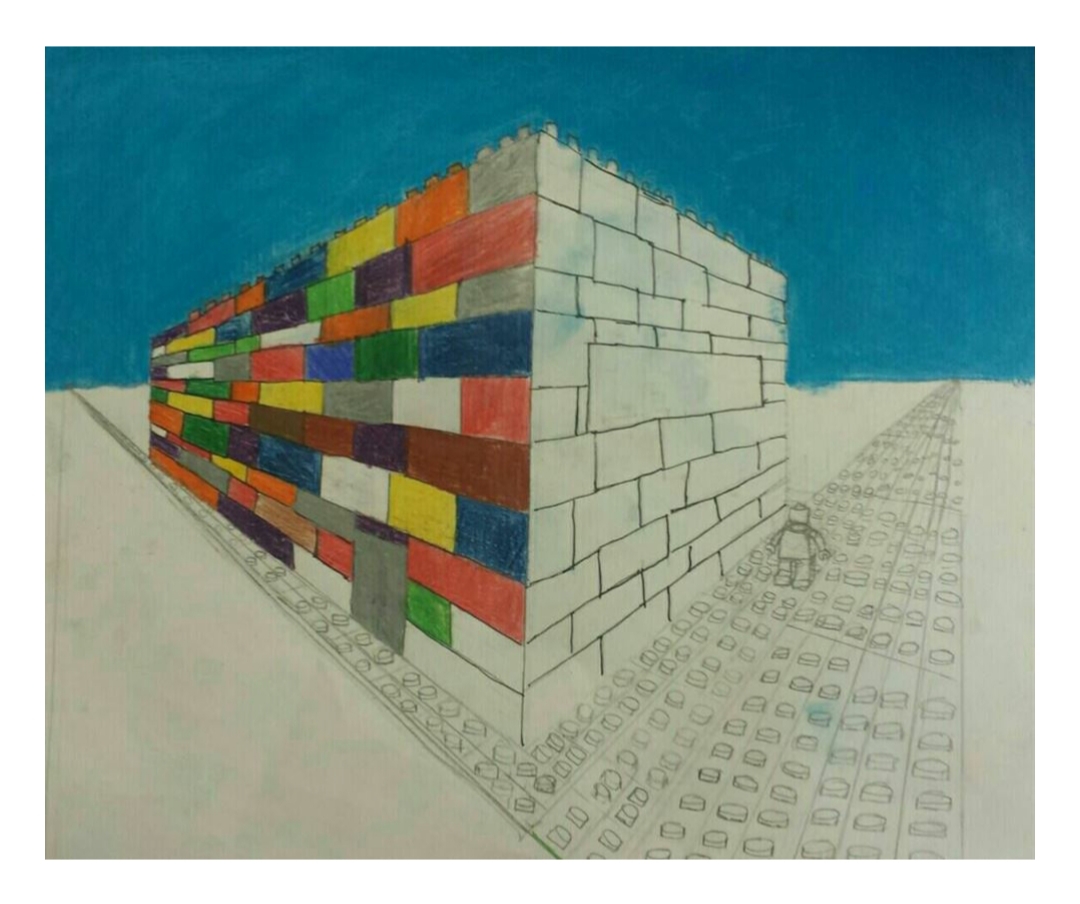
Some Student examples of one & two point perspective drawing!

Take a look at other projects you can do at home as well as upcoming lessons, both in person & virtual!

Art, Art activities, Craft, DIY, Make, Create, & Share!

Painted Watermelon Flower Pots!

Bring on the summer vibes with this fun and easy painted flower pot!

What you need:

  • Terracotta flower pot – mine is approx. 6″
  • Krylon, indoor/outdoor, Gloss Clear Coat
  • Acrylic craft paints – I use Apple Barrel bran in Spring Green, Bright Red, & white.
  • Sharpie Marker
  • 3/4″ Paint brush (or similar)

Step one: Paint the rim of your flower pot with green – also cover the rim on the inside portion of your flower pot too! (Note: if you’re re purposing an old flower pot make sure it’s scrubbed clean and dry!) It may require two coats of paint – in this case let your first layer dry completely before applying the second.

Step two: Mix together some red and white paint to create a dark pink color for your watermelon – add little bits of white to your red at a time until you get the color you’d like! Paint the whole bottom part of your flower pot with your pink color!

Step three: To add the light green stripes on the rim of your flower pot, mix a little white & green paint together. Once you have a light green, we want to use a “dry brush” technique for creating the stripes on your rim. This means that we don’t want a lot of paint on your brush and we want to see the texture of the brush stroke show up on your pot. To do this, wipe off most of the green paint from your brush and then paint your stripe! Remember we want to see the texture and create stripes that are all different!

Step four: Once your flower pot is completely dry, apply your clear coat. Let dry, and then using your Sharpie, draw your watermelon seeds!

Have fun creating this simple Summer project! Use your finished watermelon pot to hold pencils, start seedlings, as a cover for a plastic potted plant, to hold kitchen utensils, or just as a decoration!

Art, Art activities, Craft, DIY, Drawing, Make, Create, & Share!

Scratch Art

Scratch art or scratch board is a fun type of art where you typically scratch the surface of a paper or board, of a darker color, to reveal a lighter color or white. This easy project is a fun way you can create your own scratch art at home!

What you need:

  • Oil Pastels
  • Black Acrylic Paint
  • Card stock
  • Toothpick or Wooden Skewer
  • Paint Brush

Step one: Cut your card stock to the desired size (mine is approx. 6″x6″) and color it in completely with your oil pastels! Make sure to press firmly and fill in any white spots of paper.

Step two: Water down some of your black acrylic paint – we want to thin the paint out just a little but not enough that it’s dripping off your brush. Paint your entire piece of paper – going over the oil pastel you colored in the first step!

Step three: Let your paint dry and then use your toothpick or wooden skewer to scratch the black paint off the surface of your oil pastel! If you make a mistake you can cover it up with a little more black paint.

Continue scratching your design until you’re finished!

Not sure what to draw? Try a scratch art zentangle – check out this post on how to create a zentangle and apply the method to your scratch art! Send me photos of your scratch art to add to the followers gallery!

Art, Art activities, Craft, DIY, Drawing, Make, Create, & Share!

Shrinky Dinks

These have always been a student favorite! It’s like a magic art project – you draw on the shrink film, heat it up, and watch it shrink! Shrink film is so much fun, there’s really a lot of different ways you can create with it – it’s not just for kids!

What is it? Shrinky dinks are a type of plastic – polystyrene. Certain types of polystyrene are often used in food packaging and containers, it’s got the number 6 plastic code…..which also means if you have a take out container or some other type of plastic with the number 6 plastic code, you can make a shrinky dink out of it!

You can also buy Shrinky Dink sheets. I used the “Ruff n’ Ready” sheets. They’re my favorite, with one side that has a sanded surface, which, takes mediums really well! However, you can re-create this with recycled plastics too – just use some sandpaper to scratch up your plastic!

Shrinky dinks shrink about 1/3 their original size when heated – I use a small craft oven; a toaster oven, kitchen oven, or heat gun, can also be used! When they shrink, the colors on your artwork become more condensed, making them darker. I typically use colored pencils or markers on the shrink film. I’ve also use chalk pastels and pens. You can cut shapes out of the shrink film before you shrink it, as well as punch holes in it for key chains, etc.

For this project I’m making a key chain but check out some other ideas of things you can create at the bottom of the post! I’ll also be drawing my own design but as this shrink film is transparent you can also trace a page from a coloring book, magazine or book!

What you need:

  • Shrink Film, or #6 Plastic
  • Scissors
  • Hole Punch
  • Colored pencils or Markers & a Sharpie pen
  • Pencil
  • Paper
  • Key Chain – unless you plan to make something else!

Step one: Cut your shrink film to the desired size – keep in mind it shrinks to about 1/3 it’s original size! Trace your piece of shrink film on a sheet of paper.

Step two: Draw your design on your sheet of paper with a pencil – once you’re happy with your design trace it onto your shrink film with a sharpie pen. You can tape your shrink film to your paper to help keep it from moving!

Step three: Color in your shrink film design – I used colored pencils but you can use markers or pens as well!

Step four: Once your design is colored, punch a hold in your shrink film, using a hole punch, so you can turn it into a key chain later!

Step five: You can also cut out around your design if desired!

Step six: Bake your shrink film! 325* F for just a couple minuets – You’ll notice it crinkles up and then will flatten back out as a much smaller and thicker piece of plastic.

Let your shrink film cool for a few minuets. It’s fun to see how much it shrinks compared to your original drawing!

As it shrinks your colors also become more condensed, so they appear darker!

Step seven: Add your key chain pieces to your shrink film!

Trace a coloring book page instead of drawing your own design

Besides a key chain you could also turn your Shrinky Dinks into zipper pulls, magnets, pins, hair clips, jewelry, mini artworks, or anything else you can think of! I use the Shrinky Dink “Ruff n’ Ready” variety but they also offer several other types that you can use for different techniques!

Send me your Shrinky Dink creations to add to the Followers Gallery!

Art, Craft, DIY, Make, Create, & Share!, origami, paper art

Origami Bookmark Monsters!

A quick way to get creative and have some fun while making a little piece of art you can use to mark the pages of your favorite books! We’re going to be making our bookmarks into monsters but after folding the base you can turn your bookmark into anything!

What You Need:

  • Paper – I used white printer paper, cut to a 5″x 5″ square, for the bookmark
  • Construction paper or colored paper for details on your monster
  • Markers or colored pencils
  • Scissors
  • Glue stick

Step one: First we’ll be folding your bookmark – start with your 5″x 5″ square of paper and fold in half, and then fold in half again. Open your paper back up – you should have a horizontal and vertical crease that runs through the center of your paper.

Step two: Fold your paper, corner, to corner, forming a triangle. Unfold and then fold the bottom corner to the center mark.

Step three: Fold the bottom edge up on the center crease. Then take the two bottom corners and fold up to the top point.

Step four: If you carefully look inside your origami piece you’ll see there’s a little pocket that’s been formed – Take the two point pieces you just folded up in the last step, pull them back slightly and then fold them down, inside the triangle pocket.

Step five: Now you have your origami bookmark! Let’s turn it into a monster! Cut a piece of colored paper into a 2″x 2″ square and glue it inside your bookmark, so half of the square is visible (make sure not to glue the pocket together as this is how it stays on your book corner) – this will be the inside color of your monsters mouth. Cut pieces of paper to use as teeth for your monster, I used small triangles and rectangular shapes for my teeth. Cut circle shapes for you eyes or spots on your monster – you can use paper punches or a hole punch too.

Step six: Color your monster with your markers or colored pencils and add details like scales, fur, spots, etc.! Color your eyes on the circle pieces you cut.

Step seven: Assemble and glue all of your elements together!

Slide your book page inside the monsters mouth to mark your page!

Make a whole bunch of fun monster bookmarks! You can also use googly eyes, stickers, glitter, pom-poms, pipe cleaner, etc. for details on your monsters! Or get creative and turn your origami into something besides a monster! Send me pictures of your bookmarks to add to our followers gallery!

Art, Craft, DIY, Drawing, Make, Create, & Share!

Finger Print Doodle Art

Get creative and make some fun art that all starts with your finger prints! It’s a simple and easy project that you can turn into some charming pieces of art!

What you need:

  • Ink Pads or Washable Markers
  • Paper – I prefer card stock, but any white or light colored paper with a smooth surface will work!
  • A Sharpie marker or pen (or any felt tip pen & marker)
  • Some paper towels

Here’s the basic process:

We’re pretty much making your finger into a stamp – so the first thing you need to do is cover your finger print in ink! If you don’t have an ink pad you can use washable markers and color your finger prints instead! Try using your thumb and pinky finger to make different size prints!

Once your finger is covered in ink stamp it firmly on your paper. You might be able to stamp your finger more than once before having to apply more ink. Wipe any remaining ink off your finger on a damp paper towel before using a new color or use a different finger for each color – Unless you want to mix colors 🙂

After you have some finger prints stamped onto your paper, use your Sharpie and/or pens to add details and turn your finger prints into something!

Try “building” with your finger prints to create more complex objects! Remember you can make different sizes with your thumb and pinky too!

Here’s a few more ideas for your finger print doodles:

Add other elements, like googly eyes, to your prints! Some other elements could be: glitter, feathers, sequence, pom-poms, string & ribbon!

Instead of turning your finger prints into doodles you could also use them to embellish other projects!

Use markers, colored pencils or other mediums to add additional details to your doodles – like the stem and leaf in this picture!

Turn your finished pictures into greeting cards, bookmarks, framed art, and more! Get creative and have fun! Send me pictures of your doodle creations to add to our followers gallery! Happy doodling! 🙂