Art, Art activities, Craft, DIY, Make, Create, & Share!

Wire Wrapped Sea Glass Pendants

Take your found beach glass treasures and turn them into a wearable piece of art! Great as a gift or to wear yourself. The instructions below are for making a necklace, however, you can turn your finished wire wrapped pieces into key chains, zipper pulls, pull chain pendants (for ceiling fans, etc.), ornaments, or gift toppers.

What you need:

  • Sea Glass (Either found pieces or you can purchase some from craft stores)
  • 14 Gauge aluminum wire (I use aluminum sculpture wire as it’s very easy to shape but also holds and is non staining)
  • Pliers – I prefer to have a pair of round tip pliers, needle nose pliers as well as wire cutters. See an example of the pliers I use here. The project can be completed with just a pair of needle nose pliers (and wire cutter), however, you will need one of the items below to take the place of the round pliers;
    • Wooden or metal skewer, thin diameter knitting needle, or jewelry mandrel.
  • Cord, leather, or chain for your necklace – I used 3/16″ leather lace, 16″ long.
  • Jewelry findings – For a cord necklace you will need: A clasp, two jump rings, & two fold over end caps. If you’re going with chain skip the end caps!

GETTING STARTED:

Step one: Cut a length of wire – I start with between 10″ & 16″, depending on the size of my sea glass. It’s better to have a piece that’s too large and we can trim down later.

Step two: Using your round pliers, “pinch” the wire at it’s center (or close to the center!) – see the next step if you don’t have round pliers.

Step three: Bend the wire around the round pliers, crossing the wire over one another, creating a loop. If you don’t have round pliers bend the wire around a skewer or mandrel for the same result!

Step four: Twist your wire two or three times, tight against your pliers or skewer/mandrel, just like a twist tie! You can use your needle nose pliers to twist instead of your fingers!

Step five: Remove your wire from your round pliers (or skewer/mandrel). This loop will become the top of your pendant.

Step six: Now we will create coils at each end of the wire we just created the loop on. Pinch and twist the end of the wire with your round pliers (or needle nose pliers).

Step seven: continue to twist and coil your wire around until you create a loop.

Step eight: Switch to your needle nose pliers or fingers and continue to coil the wire around the center loop. We want your coil to be flat – not like a spring.

Step nine: Coil your wire around 3-5 times. It’s okay if you coil too much – we can always uncoil later if you need more wire to wrap with!

Step ten: Repeat with the other end of your wire!

WRAPPING THE SEA GLASS:

Step one: Place the piece of sea glass you would like to wrap between your wire.

Step two: Tightly bend and wrap your wire around your glass – try to wrap around all sides/edges of the glass. It’s okay to overlap and cross your wire. If you feel you need more wire to wrap, try to uncoil a little from your ends to give you more slack.

Step three: Press your coils down on your glass – I have a coil on each side of this pendant but it’s okay if they both are on one side as well! Make sure your glass is secure and won’t fall out! If it does simply undo & repeat the last step until you have it wrapped tightly!

ADDING A CORD:

Step one: Cut your cord to the desired length – mine’s approx. 16″. Place through your loop.

Step two: Fasten the end caps on your cord – place the cord inside the cap…

pinch one side of the cap down, sandwiching your cord between the metal. Pinch down the other side. Squeeze tight to secure your cord in the metal!

Step three: Repeat with the other end of your cord.

Step four: Use a jump ring to attach your clasp to one side of your end cap.

Step five: Place a jump ring on the other end cap for your clasp to connect to!

Step six: Wear your wire wrapped pendant!

This project is a lot of fun and a great way to make some handmade gifts! Try using different types & gauges of wire, wrapping with more than one piece of wire, creating more coils, etc. for more variety! You can also wrap stones, pebbles, and marbles for a different look!

Take a look at some upcoming classes and find more projects to do at home here!

Art, Art activities, DIY, Make, Create, & Share!

DIY Bird Feeder!

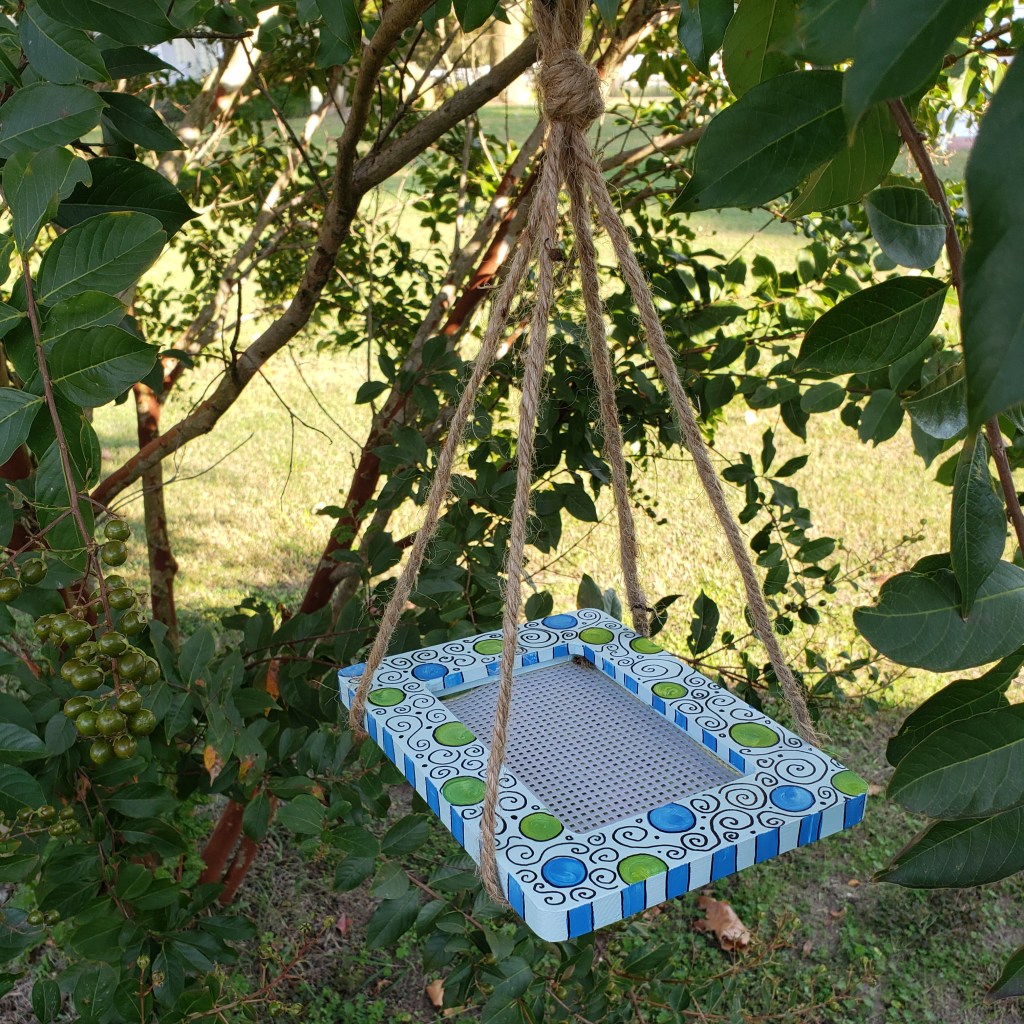
Make a little bird feeder for your yard! Paint, decorate, and design your own to give as a gift or keep for yourself! This cute little platform feeder is a simple and fun project!

What you need:

  • Wooden craft picture frame – mine is approx. 8″x6″ with a 4″x6″ opening
  • Acrylic craft paints in desired colors
  • Paint brushes
  • Sharpie
  • Krylon clear gloss outdoor spray sealer
  • Flat thumb tacks – Use stainless steel ones for longer lasting outdoor results
  • Plastic mesh cut to the opening size of your frame (I used needle point plastic but you could also use aluminum gutter shield, or plastic food mesh – if you have some with small enough gaps to hold birdseed!
  • Twine, rope, chain, leather, or any similar material suitable to use outdoors – I used approx. 6′ of jute, cut into two, 3′ pieces
  • Hammer

PAINTING YOUR FRAME:

Step one: Paint both sides and all edges of your frame one color.

Step two: Let your first layer of paint dry (use a hairdryer to speed up the dry time) and apply a second layer of paint if needed!

Step three: Add some designs and patterns with your other colors – I did dots and stripes! Let your paint dry completely before moving on!

Step four: Apply the outdoor sealer – do this outside on a protected work surface. Apply the sealer to both sides and edges of your frame – letting it dry completely before flipping your frame.

Step five: Once your sealer is completely dry use a sharpie to outline and add details to your painted design. I decided to cover most of my painted area with additional doodles!

ASSEMBLING YOUR FEEDER:

Step one: If using jute, twine, or rope, line up your two 3′ pieces and fold in half, creating a loop as shown in the first photo. Make sure the ends of your rope are even. Gathering all four strands of rope, tie a knot towards the top – leaving a loop, shown in the second picture.

Step two: Attach your rope and mesh to the frame with a thumb tack. Sandwich the ends of your rope between the mesh and the frame. Use a hammer to make sure your tack is firmly pressed into your wooden frame.

Step three: Continue to add all 4 pieces of your rope to the frame in the same manor! Make sure the knot and strands of rope are not twisted or tangled before attaching!

Step four: Add extra thumb tacks to your mesh to keep it securely in place!

Step five: Hang and fill your platform bird feeder!

Where to hang your feeder: Depending on where you place your feeder will determine what types of birds you attract (along with feeder type & seed). Attract the most birds by offering a range of feeders & food placed in various locations! Most feeders do best in a quiet, semi-sheltered area, or near shrubs & trees so birds can rest and hide from predators. Make sure you also have a good viewing point of your feeder from inside! Placing your platform feeder closer to the ground will attract ground-feeding birds such as, Juncos, doves, sparrows, & blackbirds. Placing your feeder up higher will attract birds such as, sparrows, finches, & titmice!  

What to put in your feeder: Different foods can attract different birds to your feeder – some types of birds are picky and only eat certain things while others will eat most anything you put out! I like to use black oil sunflower seeds or a seed mix. You can also try foods such as, peanuts (raw kernels only) and other nuts as well as coconuts (fresh, cut open), stale breads, cakes, & cookies (no chocolate). Fruits such as apples, oranges, grapes, & bananas. With foods that you put out, make sure to keep your feeder clean- and pick-up uneaten foods that could attract rodents, insects and other pests as well as create mold & bacteria growth.  

Feeder care: Feeders can become messy quick! Platform feeders can hold trampled food and droppings, and should be regularly cleaned out. A little soapy water and rinse should be sufficient. Re-coat your feeder with a clear coat each season to help keep it in shape (clean and dry your frame before re-coating).  

Making more feeders: If you had fun with this project, and want to make more, here are some various ideas for supplies! 

  • The frame in this kit is a small wooden craft frame, you could also re-purpose old picture frames in the same manor! Outdoor spray paint is a quick and easy way to cover old frames! 
  • I used needle point plastic in this kit for the mesh to hold seed, you could also use aluminum gutter shield, plastic food mesh, or window screen material. Just be sure your mesh material has small enough gaps to hold seed!  
  • The included hanging material is jute – eventually this will get weathered down, as an alternative, you could use twine, rope, chain, leather, or any similar material suitable to use outdoors.  
  • The included thumb tacks are stainless steel – this helps with the longevity of them being out in the weather! Depending on the frame being used, nails, screws, & staples could be utilized instead of tacks!  

BONUS PROJECT: Make a winter treat for your birds! What you’ll need: Pinecones, String or Wire, Peanutbutter (or Crisco), & Birdseed. Gather your pinecones and tie a string or piece of wire tightly to the top of your pinecone! Next completely cover your pinecone with peanutbutter or crisco – pushing it into all the gaps & spaces on your pinecone. (Note* if your pinecones are not open, let them set inside for a day or so or place them in your oven on 200*F for 20 min or so to speed up the process). Roll your covered pinecone in birdseed and hang up!  

Like this project? It was from one of our Creative Science lessons – a partner program between Brad Hartle, 4-H STEM educator with UMES and myself! We work together to create fun & engaging lessons that involve art and science for youth! Check out other projects to do at home and upcoming creative science lessons here!

Creative Science: Feed the Birds
Art, Happenings, Make, Create, & Share!, student artwork

Student Spotlight! (February 2021)

Each month I will be spotlighting one of my students – past or present, and their artistic ventures! I work with students of all ages and abilities and you’ll get to learn a little bit about these amazing artists and their work!

Our February spotlight is on:

Calli Gleason

My name is Calli and I am in the 4th grade. I love cats! I enjoy all things cats: books, pictures, creating stories, and drawing them! My favorite type of cat is the Siamese cat (They really like to chatter!). Cats give me lots of inspiration to create art.  

I could draw all day long. I have learned a lot of drawing tips and tricks from taking classes with Miss Jenell. I am very thankful she is helping me get better at drawing. I have been taking art class with her since I was four years old. I am now 9 years old! My mom signed me up to take an art class with Miss Jenell and I have loved it ever since. 

 My favorite way to create art is to draw a picture with pencil then color it in with paint or crayon. Some other forms of art I enjoy are singing, playing piano, and theater. I can express my feelings through art. Bob Ross did an excellent job painting with feelings. Happy trees! One day I would like to try painting with a chisel to make mountains like he did. My favorite thing about art is when artists create a painting that looks real. Mary Blaire is my favorite artist because she created a lot of Disney characters. I like how she boldly mixed different colors together.  


“Cat Catastrophe” Mixed Medium: Pictures, paint 
“Birds Eye” Water Color
“Solar System” Paint
“Snowy Alley” Water color

Calli has an excellent imagination and puts it to good use in her artwork, creating stories and scenes that are full of life! Her artwork reflects her happy personality and is sure to put a smile on the viewers face! The fearlessness she has in trying new mediums and styles, while continuing to develop her own unique style, will continue to help her grow as an artist! Keep up all the good work Calli!


Art, Art activities, Craft, decorating, DIY, Make, Create, & Share!, origami, paper art

Let it Snow: Paper Snowflake DIY!

Cut paper snowflakes are a fun easy project that you can create so many variations with and they make excellent winter decorations! In nature most snowflakes are 6 sided, many times when we make paper snowflakes, we create 4 or 8 sided snowflakes – below you will find instructions for folding 6 pointed, 8 pointed and 12 pointed! Once you get the hang of these folds and where to draw your design you will have some amazing paper snowflakes! These can also make a great lesson to incorporate symmetry, angles, fractals, & kirigami into!

What you need:

  • Paper – I just prefer to use plain white copy paper but any thin paper will do. You can even create colorful snowflakes!
  • Scissors – Because we’ll be cutting through several layers of paper at once, be sure you have a sharp pair! If you plan to do a lot of smaller details on your snowflake, small sewing scissors can come in handy!
  • X-Acto Knives – These are optional to be used in place of the scissors or to make cuts that are not along the edge of your folded snowflake.
  • Pencil for drawing designs out if desired!

MAKING YOUR PAPER SQUARE:

If you’re starting with plain copy paper, the first thing to do is make your paper square – we will need to start with a square piece of paper for any of the snowflakes below!

Step one: Fold the bottom corner of your paper up, and to the opposite side, until you’ve created a point at the bottom of your paper.

This is what it looks like unfolded….

Step two: Cut off the single layer of paper that you see.

Step three: Open your paper back up – square!

You can make your squares any size! Try using the piece of paper you cut off of your rectangle to make a smaller square (and smaller snowflake!).

6 SIDED SNOWFLAKE: This method of folding gives your snowflake 6 points/sides just like a snowflake found in nature! This is also the easiest method listed to cut as there’s less layers of paper to cut through!

Step one: Start with a square piece of paper, leave it folded. (Or fold a square piece of paper from corner to corner)

Step two: Find the center of the bottom of your triangle (shown in the next photo) – do this by folding corner, along the bottom edge, and “pinch” your paper in the center. This way you don’t create a crease line all the way to the point of your paper!

Step three: Make sure you have your paper opened back up after “pinching” the middle point of your paper!

Step four: We will be folding the corners of your paper up on the two lines shown in the picture – you can use a protractor for this, marking the crease lines at 60-degrees.

Step five: Fold the right flap up on the 60-degree mark shown in step four.

Step six: Flip your whole paper over, keeping the point towards you.

Step seven: Fold the right flap up on your other 60-degree mark – the two sides of your paper should all be even.

Step eight: Cut the top triangles off of your paper, making the top layers of paper all even.

Step nine: Draw out your design; I like to have my design go all the way, or almost all of the way, to the top corners, and dip low between them. Then I draw shapes & designs on the edges of my triangle, these shapes start and stop on the same edge of my paper – this keeps my snowflake whole!

Step ten: Cut out your design – it’s easiest to start by cutting your little designs first and then your larger areas.

You can also use the extra paper you cut to create a square and make mini snowflakes!

8 SIDED SNOWFLAKE: This method gives your a couple more points than the first!

Step one: Start with a square piece of paper.

Step two: Fold in half, edge to edge.

Step three: Fold in half again, to create a square.

Step four: Check the edges of your square – point the corner that has all open flaps of paper away from you, and the corner that is the center of your paper (or no flaps of paper) pointed towards you!

Step five: Fold the square in half, right point to left point (keeping the open ends at the top and center towards you).

Step six: Draw out your design!

Step seven: Cut out your smaller details first…..

Step eight: Cut out your larger area & carefully unfold!

12 SIDED SNOWFLAKE: This is my favorite snowflake fold – because it’s 12 layers it can be harder to cut but it makes the snowflakes look more intricate and delicate!

Step one: Start with a square piece of paper!

Step two: Fold your paper in half, from corner, to corner.

Step three: Fold your paper in half again, with your folded edge from the last step on the bottom.

Step four: This next step can be tricky until you’ve done it a few times! We will be folding your paper into 3rds, shown on the fold lines your can see in the photo above. You can use a protractor to do this (dividing it into 3rds, each at a 30-degree angle) or just eyeball it and fold & unfold, until you get it right in the next steps! The more exact you line up and fold your paper, the better your cuts and snowflake will come out, so take your time on getting things lined up!

Step four: With the point of your paper facing you, fold the left side of your paper over on your first 30-degree mark or the first line seen in the picture on step three.

Step five: Flip your whole paper over, keeping the point towards you.

Step six: Fold the left side of your paper over to line up with the right edge, and the other 30-degree mark on your paper.

Step seven: Now you have your papers folded, cut the top triangle pieces off, so that all of your paper layers are even at the top.

Step eight: Draw your designs on your snowflakes! Keep your designs on the edges of your triangles, being sure not to cut all the way from one edge to the other.

Step nine: Cut your snowflake out on your lines! Carefully use an Xacto knife for small cuts if needed! Open your snowflake gently!

Your finished snowflakes can be used to decorate your windows – they look awesome from both inside and out, especially when it’s dark outside! I use a glue stick to attach my snowflakes to the window. You could also use double sided tape or hand them from a string!

You can make smaller or larger snowflakes with the same folds as above – just start out with smaller or larger squares of paper! The snowflakes above that have the objects and scenes incorporated into them are large, approx. 20″ – 24″ wide! They also have cuts that were created “inside” the folded triangle, not along the edge, I had to use a hole punch and my xacto knives to remove these cuts! Keep in mind when you create objects on your snowflakes anything drawn along the edges is just half of a shape, when opened it will become whole!

Use your paper snowflakes for other art projects too – like this mixed media encaustic piece! Paper snowflakes have been layered with different color waxes, pearl powders, & other papers to create a unique collage! I also cut some snowflakes from old book paper, tracing paper and vellum, to create different effects! You could also make a snowflake garland, use as gift topper/decorations, or on greeting cards!

Make this project? I’d love to see some photos! Check out other projects to complete at home here!

Art, Happenings, Make, Create, & Share!, student artwork

Student Spotlight! (January 2021)

Each month I will be spotlighting one of my students – past or present, and their artistic ventures! I work with students of all ages and abilities and you’ll get to learn a little bit about these amazing artists and their work!

Our January spotlight is on:

Amy Stiegler

My name is Amy Stiegler. I’m 15 years old and I’m a freshman in high school. I have been taking art lesson with Ms. Jenell since 2014. I began to take art classes after I watched a movie and drew the characters and my dad saw and signed me up. Other artists as well as things I see and experience in my life inspire me to create. I love drawing with charcoal and painting with acrylics. Other than visual arts I am interested in photography and music. With my love of music I’d like to become a singer and songwriter. My favorite piece I’ve created is a dragon. It’s my favorite because it was one of the first pieces I did and every time I look at it I get inspired to keep drawing. I listen to music or soundtracks that apply to what I’m working on. For example, when I was drawing a lion, I listened to the Lion King soundtrack. Someday I’d like to try spray painting because I feel it would be fun.

Title: Lizzy
Medium: Acrylic
Description: Lizzy is my dog and has been by my side for my entire life. She is 16 now and still as energetic as ever so it was quite the challenge to snap the photo this painting is of.

Title: Live Love Lions
Medium: (uh mixed – there’s a lot happening)
Description: When we first making this with Ms. Jenell I was very confused on how it would work together, but it’s now one of my favorites and includes maps of important places to me as well as my birthday and stars. 

Title: Canyon Moon
Medium: Acrylic
Description: I was inspired to make this painting after listening to a song called “Canyon Moon”. I painted this sometime in the middle of quarantine and was very happy that I decided against the “realistic” colors.

Amy is not afraid to get creative and once she has an idea – she’s determined to create it with the mediums at hand! She works to perfect her art until she’s happy with it and is always willing to give new techniques & mediums a try. Her artwork also reflects her fun loving personality and is sure to send a message of happiness to the viewer!

Take a look at last months student spotlight here!

Art, Art activities, Craft, DIY, Make, Create, & Share!

Arm Knitting!

Create your own chunky knit scarf or cowl with arm knitting! Use jumbo size yarn to create the chunky loose knit pictured or use larger weight yarn for a tighter knit look! You can also double up yarns and follow the same directions with two strands to give a fuller scarf look! If you’ve knitted before, your arms just replace the knitting needles! 

What you need:

  • Jumbo 7 yarn, approx. 46 yards – I used Red Heart Grande/Jumbo 7 
  • Your arms! – this is easiest with no long sleeves and no bracelets or watches on!  
  • Scissors 

Casting on: This will determine the width of your scarf – I cast on 8 stitches, which made my scarf around 8” in width – when not stretched or bunched (as the knit is very loose). Cast on more or less depending on the size of your yarn and the width you would like your scarf to be!  

  •  Step one: create a slip knot at the end of your yarn. Place your right arm inside the slip knot and pull tight. Make sure you leave a tail to your knot – around 6” or so to help tie off at the end!  

Step two: Begin casting on stiches to your arm. I added 7 more stiches for a total of eight (the slip knot becomes one of the stiches). Keep your working yarn taut with your left hand, grab the working yarn with your right hand, twisting the yarn to make a loop (pictures 1 & 3 below). Continue with the same steps until you have the desired number of stiches!  

Knitting right arm to left arm: We will be taking all the stiches cast onto your right arm and knitting them onto your left arm! The “working yarn” is the yarn coming from your skein.  

  • Step three: Take the top loop on your right hand and carefully pull the working yarn through the loop. Place the new loop you’ve pulled through onto your left wrist, dropping the old loop. Pull the working yarn to tighten the loop on your left wrist. 

Step four: Continue step three for each remaining stitch on your right hand. 

Knitting left arm to right arm: Continue to knit from your left arm to your right arm!  

  • Step five: Hold onto the working yarn firmly in your left hand. Pull the top loop over your left fist and drop. Open your left hand and place that loop onto your right wrist. Pull the working yarn to tighten the loop.  

Step six: Continue with step five for all remaining stiches on your left arm.  

Step seven: Continue knitting from your right to left arm, and left to right arm, until your scarf is the desired length – make sure to stop when you have at least 36-48″ of yarn remaining. I find it easier to end with the stiches on my right arm. 

Casting off: Now to get your scarf off of your arm! The directions below will show as if you’ve ended on your right arm, however, can be completed in the same manor if you’ve ended on your left arm. 

  • Step eight: Knit two of your stiches onto your left arm (following step three), take hold of the top loop in your left hand, pull the bottom loop on your left wrist over your fist and drop it. Open your left fist, keep this loop on your left wrist. Bring another stich from your right arm over to your left (as in step three) and repeat by holding the top loop in your left hand while you bring the bottom loop over your fist and dropping. Continue until you have one loop remaining on your left wrist.  

Step nine: Finish off your last loop by bringing your last bit of working yarn through the loop and pulling tight (if you have a long piece remaining or still have some of your skein left, trim your yarn to leave a 14-18″ piece before pulling though).  

Finishing your scarf: Weave in your tails or make your scarf into an infinity scarf/cowl by “sewing” your ends together with your tail pieces!  

Art, Art activities, Drawing, Happenings, Holiday, Make, Create, & Share!

Christmas commissions!

Now that Christmas is over I can safely share some of the commissions I’ve been working on the past few months! I enjoy getting to create these pieces that are often made in memory of a special pet or given as a personalized, memorable, gift!

Pastel 9″x12″
Pastel 8″x10″

Pastel 11″x14″

For the most part I start any commission from a clients photo, sometimes more than one photo – especially with multiple subjects or for correct coloration. The better quality photos I have to work from, the more details I am able to add in! However, I do like the occasional challenge of working from an old photo!

Pastel 9″x12″
Pastel 9″x12″

Pastel 9″x12″

While pastels are one of my favorite mediums (you can read more about what pastels I like to use here), I’m always thankful for those commissions that bring a different medium to the table and break up the pastel work!

Watercolor & Pen 10″x16″

Acrylic on canvas 8″x8″

Once I begin a piece, I send in progress photos to the client for their approval of the work at different stages – I like to work with them to make any needed adjustments so the piece represents their subject and personal taste best! When the final drawing is complete and approved it’s signed and packaged before being delivered, shipped, or picked up!

Charcoal 8″x10″
Watercolor & pen, 14″x16″

Some pieces take longer than others (depending on subject, size, medium, & adjustments needed), accumulatively, the completed pieces this season took between 80 & 120 hours to complete.

Handmade & painted pig crossing sign
Painted Mailbox
Digital Logo Commission

I’m grateful to receive commission requests and be able to do what I love! Thank you for all your support this season (and all year long)!

A few pictures of the commissions in progress!

Art, Happenings, Make, Create, & Share!, student artwork

Student Spotlight! (December 2020)

Each month I will be spotlighting one of my students – past or present, and their artistic ventures! I work with students of all ages and abilities and you’ll get to learn a little bit about these amazing artists and their work! Check out all student spotlights here!

Our January spotlight is on:

Delaney Earp

I am Delaney. I am a freshman in high school and I am 14 years old. I enjoy art, playing the trumpet, and baking.

Medium: watercolor
Title: Swimming Turtle
Description: This is a watercolor painting of a turtle swimming in the ocean:

How long have you been taking art lessons?
“I have been taking art lessons since 2017.”

Why did you begin to take art lessons/how did you become interested in art? “I began taking art lessons because I wanted to become better at what I loved to do. I became interested in art when I was little and I have been drawing for a very long time.”

Medium: Acrylic 
Title: Blossoming rose
Description: This is an acrylic painting of a rose. I painted it on a small cardboard sign. The painting was then rubbed with dirt to make it look older.

What or who inspires you to create your artwork? “I create my artwork based off what I see around me. When I see something outside that I love like a pretty scene, I want to paint it.”


What are your favorite mediums and/or subjects for your artwork? “One of my favorite mediums is watercolor because it is easy to work with. When ever I make mistakes using watercolor, they can be easily hidden. Watercolor is also very beautiful and it blends so well together.”

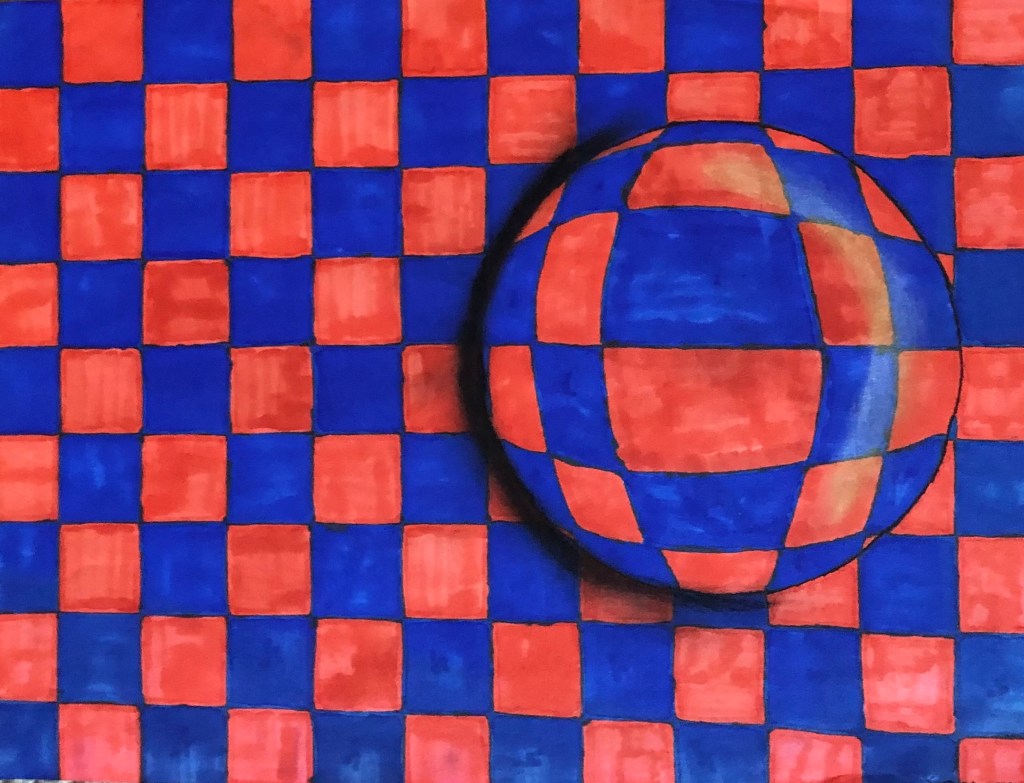
Medium: Marker
Title: A closer look
Description: This is a drawing of an orb looking shape on a checkerboard surface. The orb is magnifying the checkerboard.


Is there anything else about you that you’d like us to know? “One other thing I’d like you to know is that I don’t plan on stopping art lessons anytime soon.”

What is your favorite thing about art? “My favorite thing about art is when I make it for other people. I love to see people’s reactions when I give them something I made.”


How long does it take you to complete your artwork? “It takes me about 2 days to complete my artwork. It really depends on what I am working on. For example, something like an acrylic piece takes me longer than a watercolor piece.”

Medium: Acrylic 
Title: Late night bike rides
Description: This is an acrylic painting except my canvas was a leaf. There is a man riding is bike with the sunset by his side. 

Do you have any advice for someone who wants to become an artist or improve their skills? “One piece of advice I have for someone who wants to become an artist or improve their skills is that you need to have patience. You need to take your time when working on a piece. The longer it takes, the better it will come out in the end. If you rush to finish something, it’s not going to look as nice.”


Do you have a favorite color? “Yes, my favorite color is green.”


How has your artwork improved/what have you done to keep improving as an artist? “My artwork has gotten better overtime because I always look for ways to improve my artwork. I always want to look to see what I can do differently to make sure I create something even better than before.”

Delaney takes her time and puts her best effort into her pieces of art. She’s always working to improve her skills and continues on a piece until she’s happy with it. Her persistence and outlook on learning from her own art are two things, without a doubt, that will help her continue to grow as an artist!

Art, Art activities, Craft, Make, Create, & Share!, student artwork

What’s up in the Art Room? (December)

Check out some of our current projects happening in the art room and how they’re made!

Though there’s not been as many in person classes this month, there’s still a lot going on! Check out some of the happenings below!

Virtual Paint Alongs! Although we haven’t been able to do any in person paint nights lately, we have been able to hold some paint alongs virtually! These have been a lot of fun, a great way to stay connected with friends and family and complete activities together! If you have a birthday, holiday party, club or group – or just want to get together with some friends and paint, contact me to set up a virtual paint along! Check out paint along example paintings here or request a personalized painting!

Holiday projects!

A fun alternative to plain canvas – Students painted these burlap wrapped canvas made a fun surface to make a winter inspired acrylic painting on!

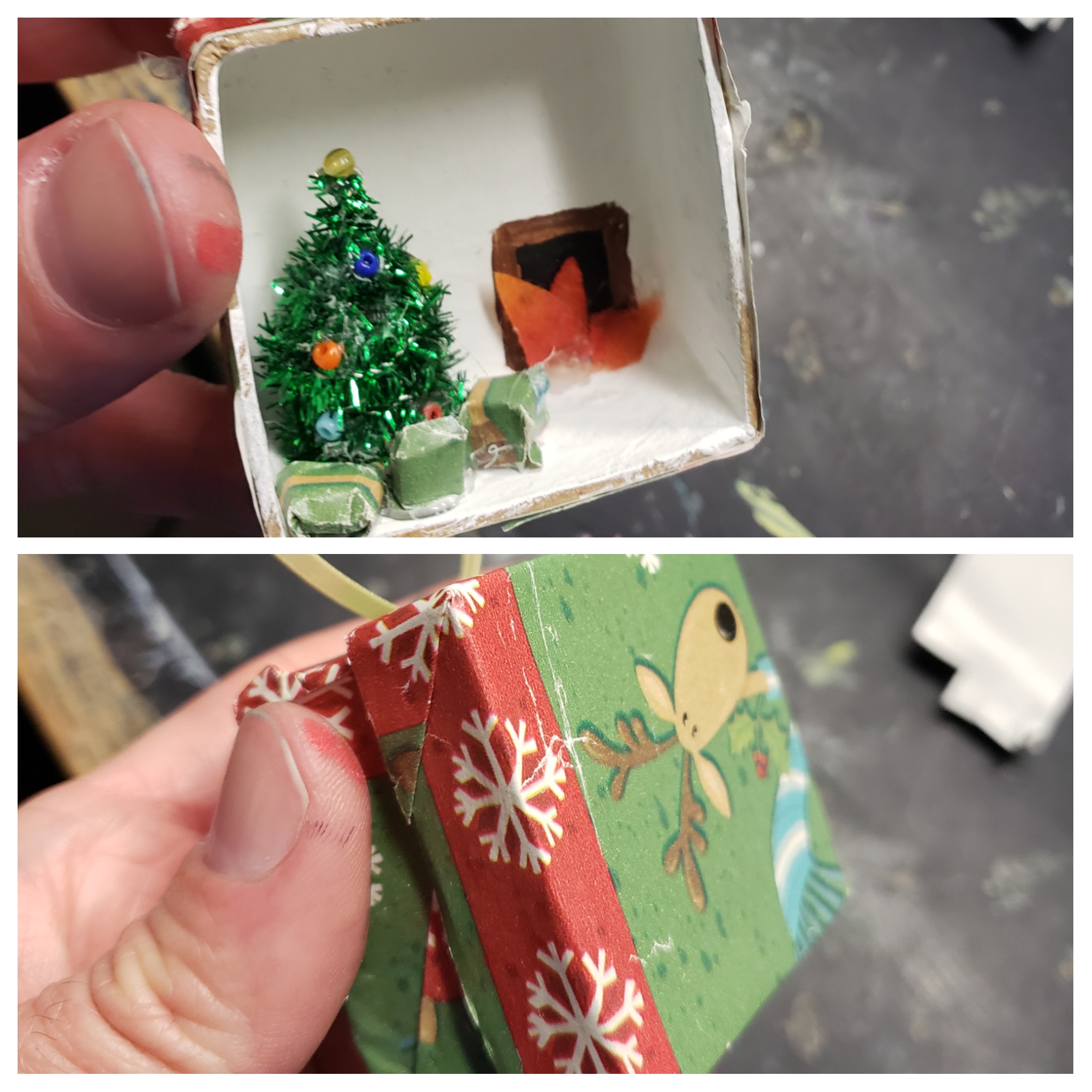
Miniature ornament scenes – students used a small chipboard box and found objects to create these fun miniature scenes in!

Encaustic Snowflake Art – Students made paper snowflakes and layered them, as well as other bits and pieces of papers, with encaustic waxes on a wooden panel to create these awesome mixed media pieces!

Ceramic Letters & Numbers! Students finished up their ceramic letters and numbers, adding them to a painted wooden board!

Prepping Grab & Go Kits! In a typical year I’d be able to hold classes at local libraries and venues – a bit different this year, getting supplies and kits together for local libraries and venues grab & go programs instead! Many of the projects I’ve posted have been created for grab & go programs. It’s been a lot of fun to make kits and being able to still keep in contact with many venues!

Upcoming Virtual classes! Also in the works are some exciting virtual Creative Science lessons – Partnered with UMES to hold a science lesson and an art project related to the topic! Youth can sign up for one, or all topics, which include; “Inking it up”, “Feed the Birds”, “Let’s Upcycle”, Explore the Deep”, & “Fish are Friends”. A supply kit is included in the cost. Check out some examples below of art projects we will complete! Find info on signing up here!

Art, Art activities, Craft, decorating, DIY, Holiday, Make, Create, & Share!

DIY Ornaments!

Create some fun little ornaments with simple supplies! Find the instructions below each of the three pictured!

Snowman ornament!

What you’ll need:

  • Mason Jar Lid (not the jar band)  
  • Small piece of sandpaper 
  • Piece of 1/4″ wired ribbon – approx. 12″
  • Two small pom-poms  
  • Piece of ribbon/twine for hanging
  • Acrylic Craft Paint (White, red or pink, Orange)  
  • Mod Podge  
  • Scissors 
  • Paint brush 
  • Sharpie pen 
  • Hot glue or craft glue 

Step one: Scuff up the mason jar lid with your sandpaper to help the paint adhere better! 

Step two: Paint your mason jar lid with white acrylic craft paint – let dry and apply a second layer if needed. 

Step three: Once your white paint is dry, use the orange paint to make your snowman’s nose – I made a dot near the center of my lid and towards the edge, and then connected them to create the nose!

Step four: Use your pink paint or make pink by mixing a little red paint to white paint and give your snowman rosy cheeks!  

Step five: Once your orange and pink are dry, apply a layer of mod podge sealer over the entire surface, let dry completely! 

 Step six: Use a sharpie pen to give your snowman eyes & a mouth – check out the pictures below for face ideas! Also outline your nose. Tip: leave a white spot in your snowman’s eye to give him a spark!  Download some additional snowman face ideas and practice your own below!

Step seven: Hot glue a ribbon to the back of your lid for a hanger!

Step eight: Cut and glue a piece of your wired ribbon, from side to side of your lid, glue pom-poms on the ends to look like ear muffs! Use leftover ribbon to make a bow for your snowman if desired!  

Tree Scene Ornament!

What you’ll need:

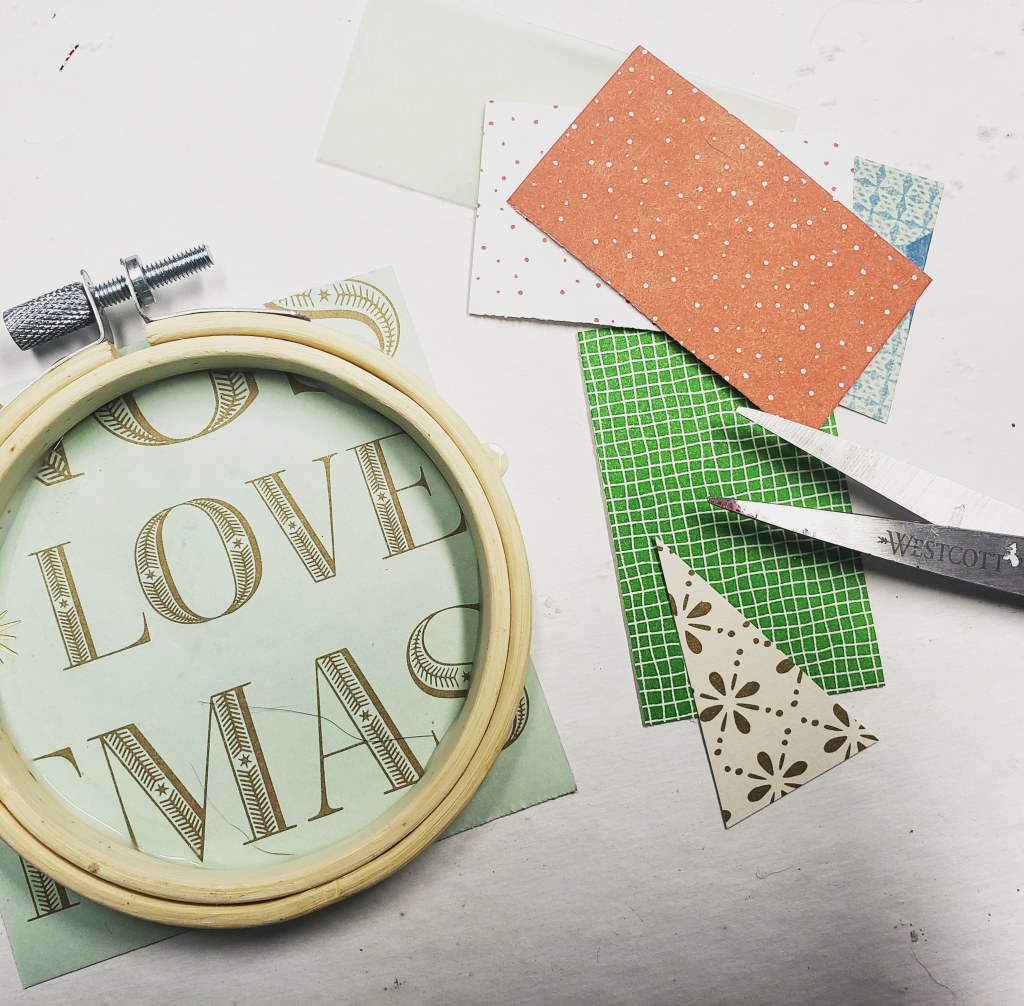
  • 3” Embroidery Hoop 
  • 2 pieces of approx. 3”x3” decorative cardstock 
  • Small pieces of decorative cardstock 
  • Mini paper snowflakes 
  • Piece of 8” burlap like ribbon 
  • 9 Small foam mounting squares  
  • Sequins 
  • Glue gun 
  • Craft Glue  
  • Glue Stick 
  • Scissors 
  • Colored Pencils 
  • Additional items to decorate with, such as, stamps, glitter, ribbon, stickers, etc.  

Step one: Cut a piece of cardstock large enough to glue to the back of your hoop – this will become the background to your tree scene, use craft glue to adhere it to your embroidery hoop.  

Step two: Work on getting your trees ready while your hoop dries! Using smaller pieces of decorative papers, cut triangles for trees! Make different shapes and sizes for added interest! 

Step three: Use colored pencils to shade the side/edges of your trees, giving them a border!  

Step four: If your hoop glue is dry, cut the paper off around the edges, you can also use an x-acto knife.  

Step five: Add your trees to the hoop! Glue some trees directly to the background paper and use the small mounting squares to adhere some trees, making them “pop” off of the surface – stack mounting squares to add more depth.  

Step six: Add sequins as tree toppers and/or ornaments on your trees and add the paper snowflakes (I cut one of my snowflakes in half to use around the edge). Add any other desired decorations and glue the piece of burlap like ribbon to the back for hanging!  

Wreath Ornament!

What you’ll need:

  • Mason Jar Lid Band 
  • 6 Pieces of green pipe cleaner 
  • Piece of 12” ribbon/twine for hanging  
  • Glue gun or craft glue 
  • Items to decorate your wreath with – I used pieces of artificial greenery and berries. Some other ideas may include miniature ornaments, pom poms, ribbon, etc. 

Step one: Wrap all 6 pieces of green pipe cleaner around your mason jar band! 

Step two: Collect items to add to your wreath 

Step three: Glue your items to your wreath!  

Step four: Add a ribbon to hang your ornament!

Give as gifts, hang on your tree, or use as gift toppers! Have fun making your own!