Art, Art activities, Craft, DIY, Make, Create, & Share!

Polymer Clay Mushroom Bookmarks!

Create a fun little bookmark out of polymer clay!

What you need:

  • Polymer Clay – I used white, however, any lighter color will work with the coloring techniques we will utilize. You’ll need approx. half an ounce of clay to make one mushroom (depending on how small or large you make it!), most blocks of polymer come in one ounce blocks.
  • Chalk Pastels – in the colors you would like to add to your mushroom
  • Jumbo paper clip
  • Paintbrush
  • Scrap paper
  • Tin foil
  • Wire – 18 gauge or similar
  • Pliers for cutting & twisting the wire
  • Toothpick

Step one: Gather all your supplies and knead your polymer clay so it’s soft! Cut a piece of wire approx. 2-3″ long.

Step two: Wrap your piece of wire around the end of your paper clip – make sure it’s the end of the paper clip shown in the photo (as the other end will become the part of your bookmark)! Twist your wire tightly around the paper clip, like in a twist tie fashion, this is easiest with a pair of pliers.

Step three: Divide your one ounce piece of clay into 4 pieces (or if you have 1/2 an ounce divide it into 2 pieces). Use one of your 4 pieces to form the stalk of your mushroom, pushing the wire and top part of the paper clip into your clay (if needed, you can trim your wire down so it’s not taller than the stalk!). Secure your stalk to the paper clip by making sure the clay is tight around the paperclip where it was pushed in – I used my toothpick to help with this!

Step four: Use another one of your 3 remaining pieces of clay to form the cap of your mushroom (or if starting with 1/2 an ounce, your remaining piece). Roll it into a ball and slightly flatten it – we don’t want it too thin, it should still hold it’s shape and not be floppy when picked up, not much thinner than a 1/4″.

Step five: Use the back of your paint brush, or eraser end of a pencil, to make an indent in the center of your flatten ball – this will become the underside of your mushroom cap.

Step six: With the toothpick, score the clay from the center indent made in the last step, to the outside edge, in a radial fashion.

Step seven: Now you have your cap and stalk!

Step eight: Attach the cap to your stalk with the toothpick – placing your stalk in the indent created by your pencil end or paintbrush. Blend in the stalk clay and cap clay to help secure the two pieces together. You may need to touch up your cap texture after this step! Flip your mushroom right side up and make any needed adjustments to the cap shape!

Step nine: Scribble your pastels on a scrap piece of paper to create pastel dust!

Step ten: Use your paint brush to pick up some of the pastel dust and gently brush it on to the top of your mushroom cap!

Step eleven: I brushed a layer of my lighter color pastel over the entire cap and a layer of my darker color around the edges of my cap! Once your have your cap colored to your liking, bake your mushroom at 275*F for approx. 10-15 min. (check the package directions on the clay you have compared to your mushroom thickness). I use a piece of tin foil crunched up to make a cradle for my mushroom cap as it bakes so the cam doesn’t get flattened. Let your mushroom cool and enjoy your one of a kind bookmark! Use your leftover clay to create another!

Variations: Instead of making this a bookmark, use the same steps above only use a jumbo toothpick instead of a paper clip, making your mushroom great for fairy gardens, table top gardens, or decorations for flower pots! If your paper clip is large enough to support the weight of your mushroom, you could definitely use it in a fairy garden, etc. too! Try making more than one mushroom on the same paperclip – just add more than one piece of wire to your paper clip! Use extra clay to give your mushroom dimensional spots on it’s cap before baking!

Let me know if you’ve given this project a try and check out other projects here!

Art, Art activities, card making, Craft, DIY, Make, Create, & Share!, Painting, paper art

Suminagashi

Suminagashi is one of the oldest practices of marbleizing paper! This Japanese art form can be dated back to the 12th century and it’s name, “suminagashi”, means floating ink! Floating ink is exactly what we’ll be doing to create these fun pieces of paper!

What you’ll need:

  • Plain copy paper – Just regular printer paper I found worked best!
  • A large pan of water – I used cold water in a 9″x13″ glass baking dish
  • Sumi brushes or large soft round brushes
  • Sumi ink or Higgins ink – I suggest black when first getting started for the best contrast!
  • Liquid dish soap
  • Optional: Pieces of cardstock & Mod Podge to turn your suminagashi papers into cards, tags and more!

Step one: Gather all your supplies. Fill your vat with approx. 1-2″ of water. In a small clean cup or dish, mix together a little dish soap and water (a drop of soap in 1/2 cup of water should do).

Step two: Dip one of your sumi brushes into your ink (try to just get ink on the brush bristles & avoid getting ink on the handle) and gently touch the surface of your water in your vat with the ink. You should be able to see the ink spread on the water’s surface! If it sinks to the bottom, try again, being careful not to break the waters surface with your brush. This also works best if your water is still – watch out for a lot of movement of a wobbly surface or a fan!

Step three: Grab another brush and dip this one into your soap mixture. Gently touch the surface of your water again, this time with the soapy mixture, placing your brush in the center of the ink bloom you made in the previous step! (Note: it can be hard to see the ink at first on the water’s surface, this is why I used blue ink, but don’t worry – your ink is still there!).

Step four: Continue going back and forth between your ink brush and your soapy mixture brush, repeating steps two & three, placing each alternating medium in the center of the last bloom you created. As you add more and more, it will continue to spread and fill your vat! If you’re having trouble getting your ink to float, sometimes this can mean we have too much soap in our water – try starting over with clean water and less soap in your soapy mixture!

Step five: If you have multiple colors of ink you can create your designs in the same steps above – just add in another brush with your additional color! This photo also shows a spot of ink that sank to the bottom of my vat – that blue spot we see on the left….any ink that ends up sinking, will not show on your paper, on the floating ink will become apart of your pattern!

Step six: You can also create multiple spots/centers on your surface by creating the pattern with your ink & soap mixture in various places – in this picture you can see four areas where I repeated the ink & soap mix pattern. You can also gently blow on the water’s surface to “move” your ink around on the surface. Even a little air movement will naturally do this to your ink on the surface, as well as the movement to the surface you’ll create when adding your ink and soap mixture! Be prepared to have your ink move around on the water surface slightly!

Step seven: Once you have your ink design on the surface of your water, gently place a piece of your paper on top – I find the best way to do this is to roll the paper slightly, having the center hit the water first and then carefully let the paper unroll onto the water.

Step eight: Let your paper sit in your water until the ink shows through slightly (like in the photo here or in step seven), this will only take around 30 seconds.

Step nine: Carefully lift your paper out of the water – the paper will be fragile as it’s wet, try to support it with your whole hand.

Step ten: Lay your wet paper on a flat protected work surface to dry. You may find that once dry, your paper is wrinkly – you can remedy this by placing a heavy stack of books on your paper for 24hrs (just make sure your paper is completely dry first!) or by ironing your paper flat – use a piece of parchment paper under and on top of your paper to protect from the iron.

Turn your papers into cards, gift tags, collages, bookmarks, stationary, origami, or for scrap booking projects!

Check out this method for other marbleized papers and this one to marbleize eggs! Be sure to let me know if you’ve given this a try!

Art, Art activities, Craft, DIY, Make, Create, & Share!

Wire Wrapped Sea Glass Pendants

Take your found beach glass treasures and turn them into a wearable piece of art! Great as a gift or to wear yourself. The instructions below are for making a necklace, however, you can turn your finished wire wrapped pieces into key chains, zipper pulls, pull chain pendants (for ceiling fans, etc.), ornaments, or gift toppers.

What you need:

  • Sea Glass (Either found pieces or you can purchase some from craft stores)
  • 14 Gauge aluminum wire (I use aluminum sculpture wire as it’s very easy to shape but also holds and is non staining)
  • Pliers – I prefer to have a pair of round tip pliers, needle nose pliers as well as wire cutters. See an example of the pliers I use here. The project can be completed with just a pair of needle nose pliers (and wire cutter), however, you will need one of the items below to take the place of the round pliers;
    • Wooden or metal skewer, thin diameter knitting needle, or jewelry mandrel.
  • Cord, leather, or chain for your necklace – I used 3/16″ leather lace, 16″ long.
  • Jewelry findings – For a cord necklace you will need: A clasp, two jump rings, & two fold over end caps. If you’re going with chain skip the end caps!

GETTING STARTED:

Step one: Cut a length of wire – I start with between 10″ & 16″, depending on the size of my sea glass. It’s better to have a piece that’s too large and we can trim down later.

Step two: Using your round pliers, “pinch” the wire at it’s center (or close to the center!) – see the next step if you don’t have round pliers.

Step three: Bend the wire around the round pliers, crossing the wire over one another, creating a loop. If you don’t have round pliers bend the wire around a skewer or mandrel for the same result!

Step four: Twist your wire two or three times, tight against your pliers or skewer/mandrel, just like a twist tie! You can use your needle nose pliers to twist instead of your fingers!

Step five: Remove your wire from your round pliers (or skewer/mandrel). This loop will become the top of your pendant.

Step six: Now we will create coils at each end of the wire we just created the loop on. Pinch and twist the end of the wire with your round pliers (or needle nose pliers).

Step seven: continue to twist and coil your wire around until you create a loop.

Step eight: Switch to your needle nose pliers or fingers and continue to coil the wire around the center loop. We want your coil to be flat – not like a spring.

Step nine: Coil your wire around 3-5 times. It’s okay if you coil too much – we can always uncoil later if you need more wire to wrap with!

Step ten: Repeat with the other end of your wire!

WRAPPING THE SEA GLASS:

Step one: Place the piece of sea glass you would like to wrap between your wire.

Step two: Tightly bend and wrap your wire around your glass – try to wrap around all sides/edges of the glass. It’s okay to overlap and cross your wire. If you feel you need more wire to wrap, try to uncoil a little from your ends to give you more slack.

Step three: Press your coils down on your glass – I have a coil on each side of this pendant but it’s okay if they both are on one side as well! Make sure your glass is secure and won’t fall out! If it does simply undo & repeat the last step until you have it wrapped tightly!

ADDING A CORD:

Step one: Cut your cord to the desired length – mine’s approx. 16″. Place through your loop.

Step two: Fasten the end caps on your cord – place the cord inside the cap…

pinch one side of the cap down, sandwiching your cord between the metal. Pinch down the other side. Squeeze tight to secure your cord in the metal!

Step three: Repeat with the other end of your cord.

Step four: Use a jump ring to attach your clasp to one side of your end cap.

Step five: Place a jump ring on the other end cap for your clasp to connect to!

Step six: Wear your wire wrapped pendant!

This project is a lot of fun and a great way to make some handmade gifts! Try using different types & gauges of wire, wrapping with more than one piece of wire, creating more coils, etc. for more variety! You can also wrap stones, pebbles, and marbles for a different look!

Take a look at some upcoming classes and find more projects to do at home here!

Art activities, Craft, decorating, DIY, Make, Create, & Share!, paper art

Marbleized Paper Valentine Hearts!

Marbleized paper is a lot of fun to make and you can use the papers for a variety of projects! This is a simple and easy method for creating marbleized paper with fun results every time! Turn your marbleized papers into greeting cards, bookmarks, elements in collage work, book covers, etc. or use this same method to create your marbleized effect on things like envelopes, eggs (for Easter decorations) blank sticker/label papers, etc.! Since it’s almost Valentine’s day, I thought a heart garland would be fun but you can use any shape with the same method!

What you need for Marbleized paper:

  • Shaving cream
  • Food coloring
  • Card stock
  • Wooden skewer or toothpick
  • 9″x13″ baking dish or aluminum foil pan (or something similar to be used as a vat)
  • Squeegee, ruler, or piece of cardboard (around 4″x6″)

What you need to make a heart garland:

  • Your Marbled paper!
  • Scissors
  • Pencil
  • Hole punch
  • Heart stencil or cookie cutters to trace (or heart punches)
  • String – I Used embroidery thread but you could also use twine, cotton, yarn, or smaller thread for mini garlands!

CREATING MARBLEIZED PAPER:

Step one: Fill the bottom of your vat with shaving cream!

Step two: Use your ruler, squeegee, or cardboard to smooth out your shaving cream (this doesn’t need to be perfectly smooth!).

Step three: Add drops of food coloring to your shaving cream – I just started off with a few drops of one color, we can add more colors later!

Step four: Swirl your food coloring around with your skewer or toothpick to create a marbleized effect!

Step five: Continue to move your color around by dragging your toothpick or skewer through the shaving cream and color! Be careful not to mix too much – we want to see the swirls!

Step six: Once you’re happy with your marbled look, carefully place your paper on top of your shaving cream! I find the best method is to gently roll your paper and place the middle of your paper on the shaving cream first, then letting the sides unroll into the shavings cream. This way helps reduce any air bubbles that get trapped between your paper and the shaving cream! Gently press your paper into the shaving cream!

Step seven: Pull your paper out of the shaving cream!

Step eight: Lay your paper on a flat surface, shaving cream side up!

Step nine: Use your squeegee, ruler, or cardboard, to remove the shaving cream from your paper – try to do this in one swoop of your tool. You can place the used shaving cream back into your vat and use again!

Step ten: Continue to make more papers in the same vat – smooth your shaving cream add colors and swirl! Colors will start to mix the more you use the shaving cream and eventually you may need to add new shaving cream to avoid a muddy look!

Step eleven: Let your marbleized papers dry!

MAKING A HEART GARLAND:

Step one: Trace your heart shapes on your marbleized papers!

Step two: Cut out your hearts!

Step three: Punch holes towards the top of your hearts on each side.

Step four: Take your string and string your hearts by placing the thread through the top of a hole & coming back up the bottom of the second hole!

Step five: Hang your heart garland!

Check out other projects to do at home here and let me know if you’ve given any a try!

Art, Art activities, Craft, decorating, DIY, Make, Create, & Share!, origami, paper art

Let it Snow: Paper Snowflake DIY!

Cut paper snowflakes are a fun easy project that you can create so many variations with and they make excellent winter decorations! In nature most snowflakes are 6 sided, many times when we make paper snowflakes, we create 4 or 8 sided snowflakes – below you will find instructions for folding 6 pointed, 8 pointed and 12 pointed! Once you get the hang of these folds and where to draw your design you will have some amazing paper snowflakes! These can also make a great lesson to incorporate symmetry, angles, fractals, & kirigami into!

What you need:

  • Paper – I just prefer to use plain white copy paper but any thin paper will do. You can even create colorful snowflakes!
  • Scissors – Because we’ll be cutting through several layers of paper at once, be sure you have a sharp pair! If you plan to do a lot of smaller details on your snowflake, small sewing scissors can come in handy!
  • X-Acto Knives – These are optional to be used in place of the scissors or to make cuts that are not along the edge of your folded snowflake.
  • Pencil for drawing designs out if desired!

MAKING YOUR PAPER SQUARE:

If you’re starting with plain copy paper, the first thing to do is make your paper square – we will need to start with a square piece of paper for any of the snowflakes below!

Step one: Fold the bottom corner of your paper up, and to the opposite side, until you’ve created a point at the bottom of your paper.

This is what it looks like unfolded….

Step two: Cut off the single layer of paper that you see.

Step three: Open your paper back up – square!

You can make your squares any size! Try using the piece of paper you cut off of your rectangle to make a smaller square (and smaller snowflake!).

6 SIDED SNOWFLAKE: This method of folding gives your snowflake 6 points/sides just like a snowflake found in nature! This is also the easiest method listed to cut as there’s less layers of paper to cut through!

Step one: Start with a square piece of paper, leave it folded. (Or fold a square piece of paper from corner to corner)

Step two: Find the center of the bottom of your triangle (shown in the next photo) – do this by folding corner, along the bottom edge, and “pinch” your paper in the center. This way you don’t create a crease line all the way to the point of your paper!

Step three: Make sure you have your paper opened back up after “pinching” the middle point of your paper!

Step four: We will be folding the corners of your paper up on the two lines shown in the picture – you can use a protractor for this, marking the crease lines at 60-degrees.

Step five: Fold the right flap up on the 60-degree mark shown in step four.

Step six: Flip your whole paper over, keeping the point towards you.

Step seven: Fold the right flap up on your other 60-degree mark – the two sides of your paper should all be even.

Step eight: Cut the top triangles off of your paper, making the top layers of paper all even.

Step nine: Draw out your design; I like to have my design go all the way, or almost all of the way, to the top corners, and dip low between them. Then I draw shapes & designs on the edges of my triangle, these shapes start and stop on the same edge of my paper – this keeps my snowflake whole!

Step ten: Cut out your design – it’s easiest to start by cutting your little designs first and then your larger areas.

You can also use the extra paper you cut to create a square and make mini snowflakes!

8 SIDED SNOWFLAKE: This method gives your a couple more points than the first!

Step one: Start with a square piece of paper.

Step two: Fold in half, edge to edge.

Step three: Fold in half again, to create a square.

Step four: Check the edges of your square – point the corner that has all open flaps of paper away from you, and the corner that is the center of your paper (or no flaps of paper) pointed towards you!

Step five: Fold the square in half, right point to left point (keeping the open ends at the top and center towards you).

Step six: Draw out your design!

Step seven: Cut out your smaller details first…..

Step eight: Cut out your larger area & carefully unfold!

12 SIDED SNOWFLAKE: This is my favorite snowflake fold – because it’s 12 layers it can be harder to cut but it makes the snowflakes look more intricate and delicate!

Step one: Start with a square piece of paper!

Step two: Fold your paper in half, from corner, to corner.

Step three: Fold your paper in half again, with your folded edge from the last step on the bottom.

Step four: This next step can be tricky until you’ve done it a few times! We will be folding your paper into 3rds, shown on the fold lines your can see in the photo above. You can use a protractor to do this (dividing it into 3rds, each at a 30-degree angle) or just eyeball it and fold & unfold, until you get it right in the next steps! The more exact you line up and fold your paper, the better your cuts and snowflake will come out, so take your time on getting things lined up!

Step four: With the point of your paper facing you, fold the left side of your paper over on your first 30-degree mark or the first line seen in the picture on step three.

Step five: Flip your whole paper over, keeping the point towards you.

Step six: Fold the left side of your paper over to line up with the right edge, and the other 30-degree mark on your paper.

Step seven: Now you have your papers folded, cut the top triangle pieces off, so that all of your paper layers are even at the top.

Step eight: Draw your designs on your snowflakes! Keep your designs on the edges of your triangles, being sure not to cut all the way from one edge to the other.

Step nine: Cut your snowflake out on your lines! Carefully use an Xacto knife for small cuts if needed! Open your snowflake gently!

Your finished snowflakes can be used to decorate your windows – they look awesome from both inside and out, especially when it’s dark outside! I use a glue stick to attach my snowflakes to the window. You could also use double sided tape or hand them from a string!

You can make smaller or larger snowflakes with the same folds as above – just start out with smaller or larger squares of paper! The snowflakes above that have the objects and scenes incorporated into them are large, approx. 20″ – 24″ wide! They also have cuts that were created “inside” the folded triangle, not along the edge, I had to use a hole punch and my xacto knives to remove these cuts! Keep in mind when you create objects on your snowflakes anything drawn along the edges is just half of a shape, when opened it will become whole!

Use your paper snowflakes for other art projects too – like this mixed media encaustic piece! Paper snowflakes have been layered with different color waxes, pearl powders, & other papers to create a unique collage! I also cut some snowflakes from old book paper, tracing paper and vellum, to create different effects! You could also make a snowflake garland, use as gift topper/decorations, or on greeting cards!

Make this project? I’d love to see some photos! Check out other projects to complete at home here!

Art, Art activities, Craft, DIY, Make, Create, & Share!

Arm Knitting!

Create your own chunky knit scarf or cowl with arm knitting! Use jumbo size yarn to create the chunky loose knit pictured or use larger weight yarn for a tighter knit look! You can also double up yarns and follow the same directions with two strands to give a fuller scarf look! If you’ve knitted before, your arms just replace the knitting needles! 

What you need:

  • Jumbo 7 yarn, approx. 46 yards – I used Red Heart Grande/Jumbo 7 
  • Your arms! – this is easiest with no long sleeves and no bracelets or watches on!  
  • Scissors 

Casting on: This will determine the width of your scarf – I cast on 8 stitches, which made my scarf around 8” in width – when not stretched or bunched (as the knit is very loose). Cast on more or less depending on the size of your yarn and the width you would like your scarf to be!  

  •  Step one: create a slip knot at the end of your yarn. Place your right arm inside the slip knot and pull tight. Make sure you leave a tail to your knot – around 6” or so to help tie off at the end!  

Step two: Begin casting on stiches to your arm. I added 7 more stiches for a total of eight (the slip knot becomes one of the stiches). Keep your working yarn taut with your left hand, grab the working yarn with your right hand, twisting the yarn to make a loop (pictures 1 & 3 below). Continue with the same steps until you have the desired number of stiches!  

Knitting right arm to left arm: We will be taking all the stiches cast onto your right arm and knitting them onto your left arm! The “working yarn” is the yarn coming from your skein.  

  • Step three: Take the top loop on your right hand and carefully pull the working yarn through the loop. Place the new loop you’ve pulled through onto your left wrist, dropping the old loop. Pull the working yarn to tighten the loop on your left wrist. 

Step four: Continue step three for each remaining stitch on your right hand. 

Knitting left arm to right arm: Continue to knit from your left arm to your right arm!  

  • Step five: Hold onto the working yarn firmly in your left hand. Pull the top loop over your left fist and drop. Open your left hand and place that loop onto your right wrist. Pull the working yarn to tighten the loop.  

Step six: Continue with step five for all remaining stiches on your left arm.  

Step seven: Continue knitting from your right to left arm, and left to right arm, until your scarf is the desired length – make sure to stop when you have at least 36-48″ of yarn remaining. I find it easier to end with the stiches on my right arm. 

Casting off: Now to get your scarf off of your arm! The directions below will show as if you’ve ended on your right arm, however, can be completed in the same manor if you’ve ended on your left arm. 

  • Step eight: Knit two of your stiches onto your left arm (following step three), take hold of the top loop in your left hand, pull the bottom loop on your left wrist over your fist and drop it. Open your left fist, keep this loop on your left wrist. Bring another stich from your right arm over to your left (as in step three) and repeat by holding the top loop in your left hand while you bring the bottom loop over your fist and dropping. Continue until you have one loop remaining on your left wrist.  

Step nine: Finish off your last loop by bringing your last bit of working yarn through the loop and pulling tight (if you have a long piece remaining or still have some of your skein left, trim your yarn to leave a 14-18″ piece before pulling though).  

Finishing your scarf: Weave in your tails or make your scarf into an infinity scarf/cowl by “sewing” your ends together with your tail pieces!  

Art, Art activities, Craft, Make, Create, & Share!, student artwork

What’s up in the Art Room? (December)

Check out some of our current projects happening in the art room and how they’re made!

Though there’s not been as many in person classes this month, there’s still a lot going on! Check out some of the happenings below!

Virtual Paint Alongs! Although we haven’t been able to do any in person paint nights lately, we have been able to hold some paint alongs virtually! These have been a lot of fun, a great way to stay connected with friends and family and complete activities together! If you have a birthday, holiday party, club or group – or just want to get together with some friends and paint, contact me to set up a virtual paint along! Check out paint along example paintings here or request a personalized painting!

Holiday projects!

A fun alternative to plain canvas – Students painted these burlap wrapped canvas made a fun surface to make a winter inspired acrylic painting on!

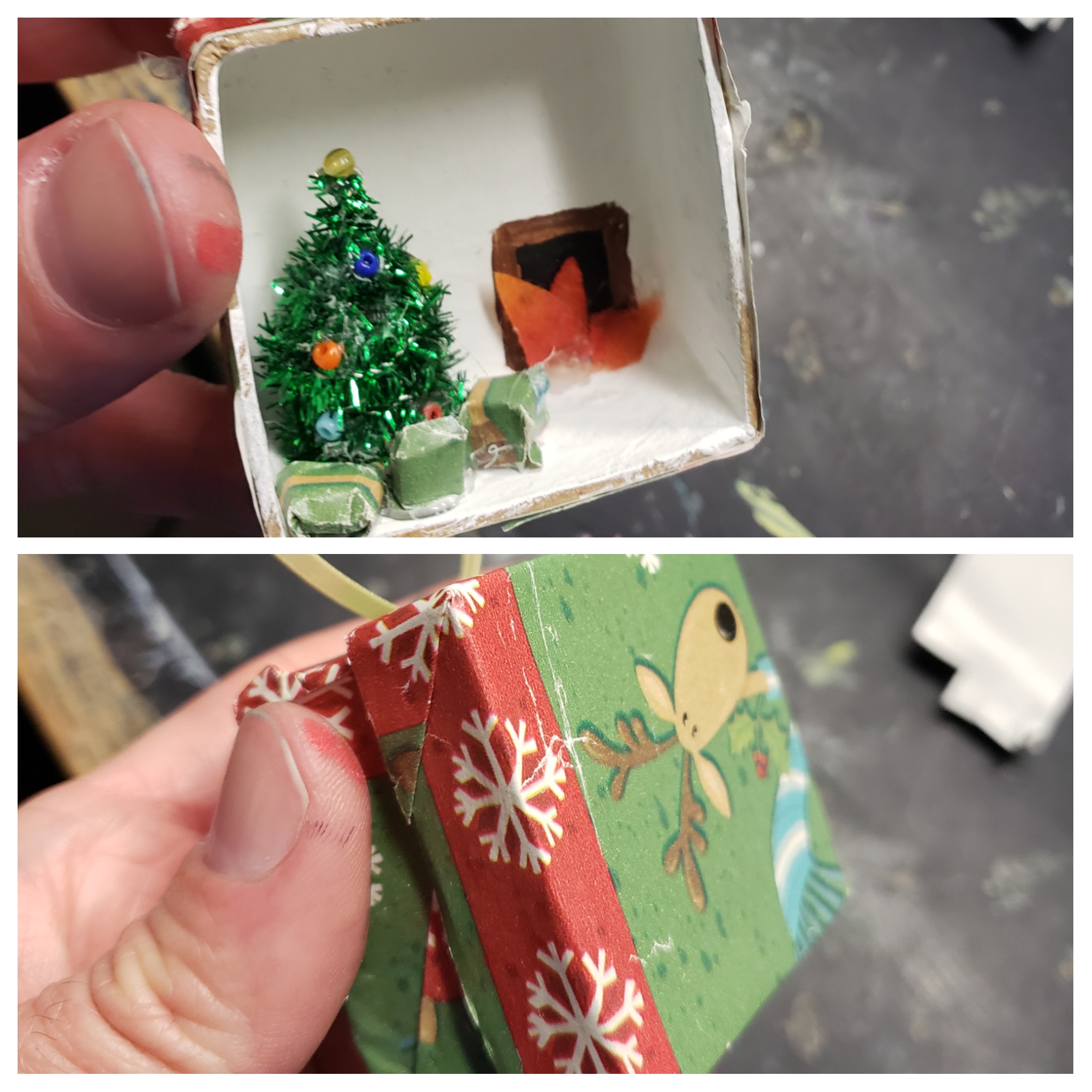
Miniature ornament scenes – students used a small chipboard box and found objects to create these fun miniature scenes in!

Encaustic Snowflake Art – Students made paper snowflakes and layered them, as well as other bits and pieces of papers, with encaustic waxes on a wooden panel to create these awesome mixed media pieces!

Ceramic Letters & Numbers! Students finished up their ceramic letters and numbers, adding them to a painted wooden board!

Prepping Grab & Go Kits! In a typical year I’d be able to hold classes at local libraries and venues – a bit different this year, getting supplies and kits together for local libraries and venues grab & go programs instead! Many of the projects I’ve posted have been created for grab & go programs. It’s been a lot of fun to make kits and being able to still keep in contact with many venues!

Upcoming Virtual classes! Also in the works are some exciting virtual Creative Science lessons – Partnered with UMES to hold a science lesson and an art project related to the topic! Youth can sign up for one, or all topics, which include; “Inking it up”, “Feed the Birds”, “Let’s Upcycle”, Explore the Deep”, & “Fish are Friends”. A supply kit is included in the cost. Check out some examples below of art projects we will complete! Find info on signing up here!

Art activities, Craft, decorating, DIY, Holiday, Make, Create, & Share!, Painting

Salt Dough Ornaments!

Salt dough is fun and easy! The dough can be baked to harden, painted with acrylics and last for years! I had my nephew create some simple cut-out ornaments but you can also make 3-D sculptures with salt dough too! There’s various recipes for creating salt dough, and other similar dough – I’ve listed one below that we used with good results!

What you’ll need:

  • Flour
  • Salt
  • Warm water
  • Cookie Cutters
  • Rolling pin
  • Straw and/or Toothpick (or something to make holes in your ornaments for hanging)
  • Cookie tray
  • Acrylic paints
  • Paint brushes
  • Spray Sealer or Mod Podge
  • Ribbon
  • OPTIONAL SUPPLIES:
  • Beads to add to your ribbon
  • Glitter
  • Stamps – for making impressions on your dough
  • Sharpies
  • Hot glue or craft glue

Step one: Mix together 2 cups of all purpose flour, 1 cup of salt and 1/2 cup of warm water in a large bowl.

Step two: Add up to 1/2 cup more of warm water, one tablespoon at a time, until dough forms. Dough should not be sticky – if it is add a bit more flour!

Step three: Kneed your dough and roll it out on a flat surface – use flour to help prevent sticking if needed. We rolled it to 1/4″ – 1/2″ thick for cut-outs. You can also make sculptures with your salt dough instead!

Step four: Use cookie cutters to cut shapes out of your salt dough. Place cut-outs on a baking sheet (I lined mine with parchment).

Step five: Before baking your salt dough make sure to put a hole in your ornaments to hang from! A plastic straw works well or a toothpick for a smaller shape! Bake your salt dough for approx. 2 hours at 275*F or until firm and dried out. Time will depend on size and thickness. You can also leave your salt dough out to air dry. Be sure to fully bake/dry out pieces before painting and sealing to ensure they’ll last a long time!

Step six: Once your pieces have been baked or dried out, use acrylic paints to paint them with! We used acrylic craft paints!

Step seven: Paint your creations and let them dry completely!

Step eight: Once your paint is dry, seal your salt dough – I brushed on a layer of glossy Mod Podge. You can also use an acrylic spray sealer instead. Let dry.

Step nine: Add ribbon and beads to hang your ornaments from! Alternatively, you could also use pipe-cleaner or wire for hangers!

Step ten: Use a sharpie to add names, dates and details to your salt dough!

Step eleven: Hang those ornaments up!

We had a lot of fun making salt dough ornaments! Create your own ornaments from cut-outs like we did or create some 3D ornaments – you can use a little water to help pieces stick together. You could also make personalized gift tags & toppers, hand/foot print plaques, small sculptures (like snowmen!), key chains, pendents, pins, or magnets! Use Popsicle sticks, wooden skewers, or toothpicks for tools. Adorn finished salt dough pieces with pom-poms, pipe-cleaner, glitter, ribbon, beads, and other craft items! Try decorating pieces with marker instead of paint for easier clean up!

Art, Art activities, Craft, decorating, DIY, Holiday, Make, Create, & Share!

DIY Ornaments!

Create some fun little ornaments with simple supplies! Find the instructions below each of the three pictured!

Snowman ornament!

What you’ll need:

  • Mason Jar Lid (not the jar band)  
  • Small piece of sandpaper 
  • Piece of 1/4″ wired ribbon – approx. 12″
  • Two small pom-poms  
  • Piece of ribbon/twine for hanging
  • Acrylic Craft Paint (White, red or pink, Orange)  
  • Mod Podge  
  • Scissors 
  • Paint brush 
  • Sharpie pen 
  • Hot glue or craft glue 

Step one: Scuff up the mason jar lid with your sandpaper to help the paint adhere better! 

Step two: Paint your mason jar lid with white acrylic craft paint – let dry and apply a second layer if needed. 

Step three: Once your white paint is dry, use the orange paint to make your snowman’s nose – I made a dot near the center of my lid and towards the edge, and then connected them to create the nose!

Step four: Use your pink paint or make pink by mixing a little red paint to white paint and give your snowman rosy cheeks!  

Step five: Once your orange and pink are dry, apply a layer of mod podge sealer over the entire surface, let dry completely! 

 Step six: Use a sharpie pen to give your snowman eyes & a mouth – check out the pictures below for face ideas! Also outline your nose. Tip: leave a white spot in your snowman’s eye to give him a spark!  Download some additional snowman face ideas and practice your own below!

Step seven: Hot glue a ribbon to the back of your lid for a hanger!

Step eight: Cut and glue a piece of your wired ribbon, from side to side of your lid, glue pom-poms on the ends to look like ear muffs! Use leftover ribbon to make a bow for your snowman if desired!  

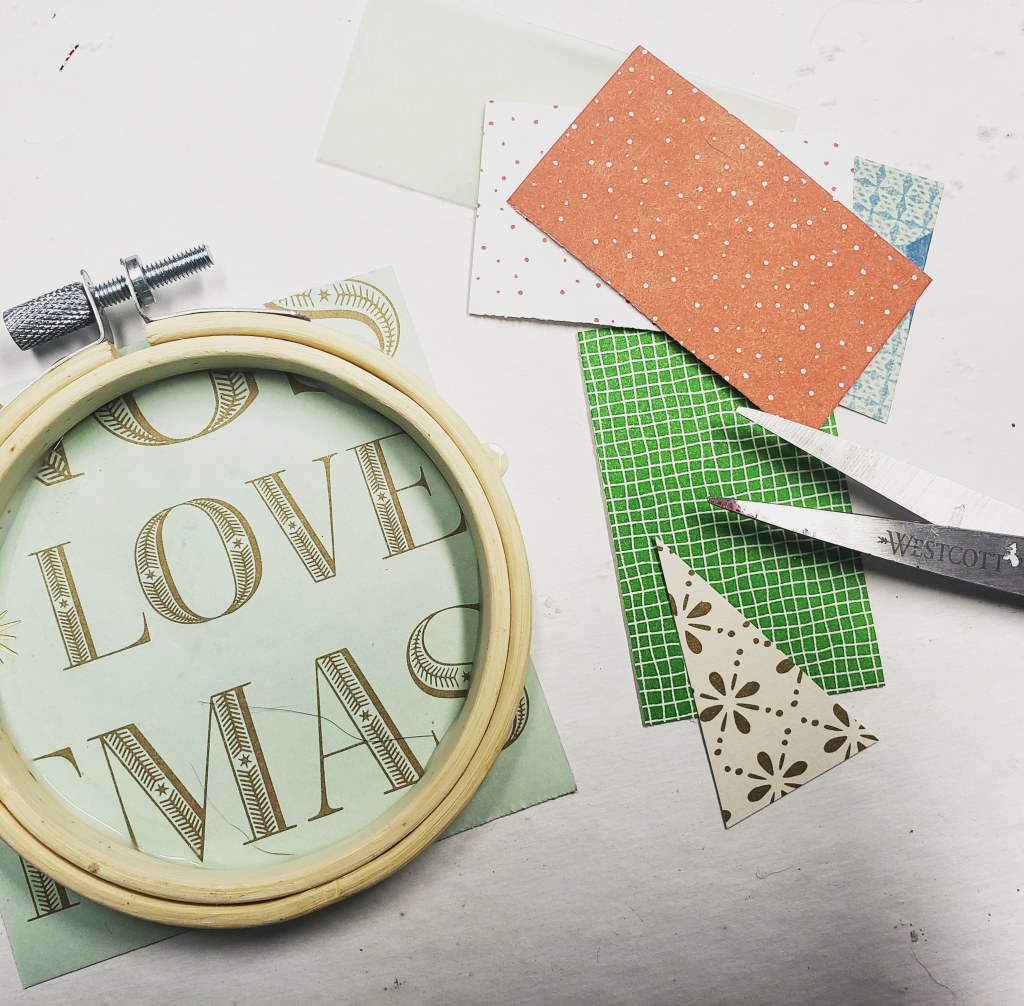
Tree Scene Ornament!

What you’ll need:

  • 3” Embroidery Hoop 
  • 2 pieces of approx. 3”x3” decorative cardstock 
  • Small pieces of decorative cardstock 
  • Mini paper snowflakes 
  • Piece of 8” burlap like ribbon 
  • 9 Small foam mounting squares  
  • Sequins 
  • Glue gun 
  • Craft Glue  
  • Glue Stick 
  • Scissors 
  • Colored Pencils 
  • Additional items to decorate with, such as, stamps, glitter, ribbon, stickers, etc.  

Step one: Cut a piece of cardstock large enough to glue to the back of your hoop – this will become the background to your tree scene, use craft glue to adhere it to your embroidery hoop.  

Step two: Work on getting your trees ready while your hoop dries! Using smaller pieces of decorative papers, cut triangles for trees! Make different shapes and sizes for added interest! 

Step three: Use colored pencils to shade the side/edges of your trees, giving them a border!  

Step four: If your hoop glue is dry, cut the paper off around the edges, you can also use an x-acto knife.  

Step five: Add your trees to the hoop! Glue some trees directly to the background paper and use the small mounting squares to adhere some trees, making them “pop” off of the surface – stack mounting squares to add more depth.  

Step six: Add sequins as tree toppers and/or ornaments on your trees and add the paper snowflakes (I cut one of my snowflakes in half to use around the edge). Add any other desired decorations and glue the piece of burlap like ribbon to the back for hanging!  

Wreath Ornament!

What you’ll need:

  • Mason Jar Lid Band 
  • 6 Pieces of green pipe cleaner 
  • Piece of 12” ribbon/twine for hanging  
  • Glue gun or craft glue 
  • Items to decorate your wreath with – I used pieces of artificial greenery and berries. Some other ideas may include miniature ornaments, pom poms, ribbon, etc. 

Step one: Wrap all 6 pieces of green pipe cleaner around your mason jar band! 

Step two: Collect items to add to your wreath 

Step three: Glue your items to your wreath!  

Step four: Add a ribbon to hang your ornament!

Give as gifts, hang on your tree, or use as gift toppers! Have fun making your own!

Art, Art activities, Craft, DIY, Make, Create, & Share!, student artwork

Radial Designs on Glass!

Create a radial design or Mandala, with glass paints, for an awesome piece of window art! Mandalas are a type of radial design – where your design radiates and repeats from a center point. Mandala comes from the Sanskrit word meaning “circle”. Mandalas can be found in many cultures and can have different symbolic meanings and processes. In Buddhist and Hindu traditions, mandalas are a spiritual symbol that represent the universe. More modern mandalas are used for meditation or just to create and enjoy beautiful designs!

What you need:

  • Picture Frame with Glass – we used 8″x10″ frames from the dollar store but any old frame will do!
  • Glass Paints – We used Gallery Glass, Martha Stewart and Arti’stick, brands, transparent, glossy, glass paints.
  • Copy/Printer Paper – that’s at least the same size of your glass/frame.
  • Pencil
  • Compass
  • Sharpie
  • Light box or sunny window!

Step one: Create your radial design! We did this with a square piece of paper, folded into fourths, from corner to corner. You can do this any size, however, ours were approx. 8.5″x8.5″ to fit our frames.

Cut out one fourth of your paper on your crease lines.

Step two: Draw your design on your cut 1/4 of paper – to make your design have a complete circle pattern, use a compass from the center of your paper out.

Step three: Fold another square piece of paper into fourths, corner to corner. We will be tracing your design onto these four sections. You can use a light box or a sunny window to help your design show through your paper – you can also go over your design with a marker before tracing to help make it more visible. Trace your first 1/4 section and then flip your triangle pattern over and trace your next 1/4 section (this will reverse your design and make the edges of your design line up). Flip it again for your next section and back over for your last section!

Step four: Next line up your radial design under your piece of glass and begin outlining your design – We used Gallery Glass Liquid Lead for this (I’ve also transferred the outliner to a small applicator bottle for easier handling and a smaller line). Let your outline dry!

Step five: While you’re waiting for your outline to dry, you can color your triangle in how you’d like to color your glass!

Step six: Once your outline is dry, use your glass paints to fill in the design with color! We used a mixture of different glass paint brands!

No matter what brand you use, you just want to make sure it’s transparent color as we want these to hang in a window and create a stained glass effect!

Step seven: Once your color has dried, place your glass back in the frame (you can use hot glue, silicone, E6000 or Goop Glue, etc. to help hold your glass in if needed), glue a ribbon to your frame or add eye hooks and a chain/ribbon for hanging! Our frames were very light weight so a hot glued ribbon worked well! Hang up your finished artwork in a sunny window! 🙂

Check out more of our radial designs here!