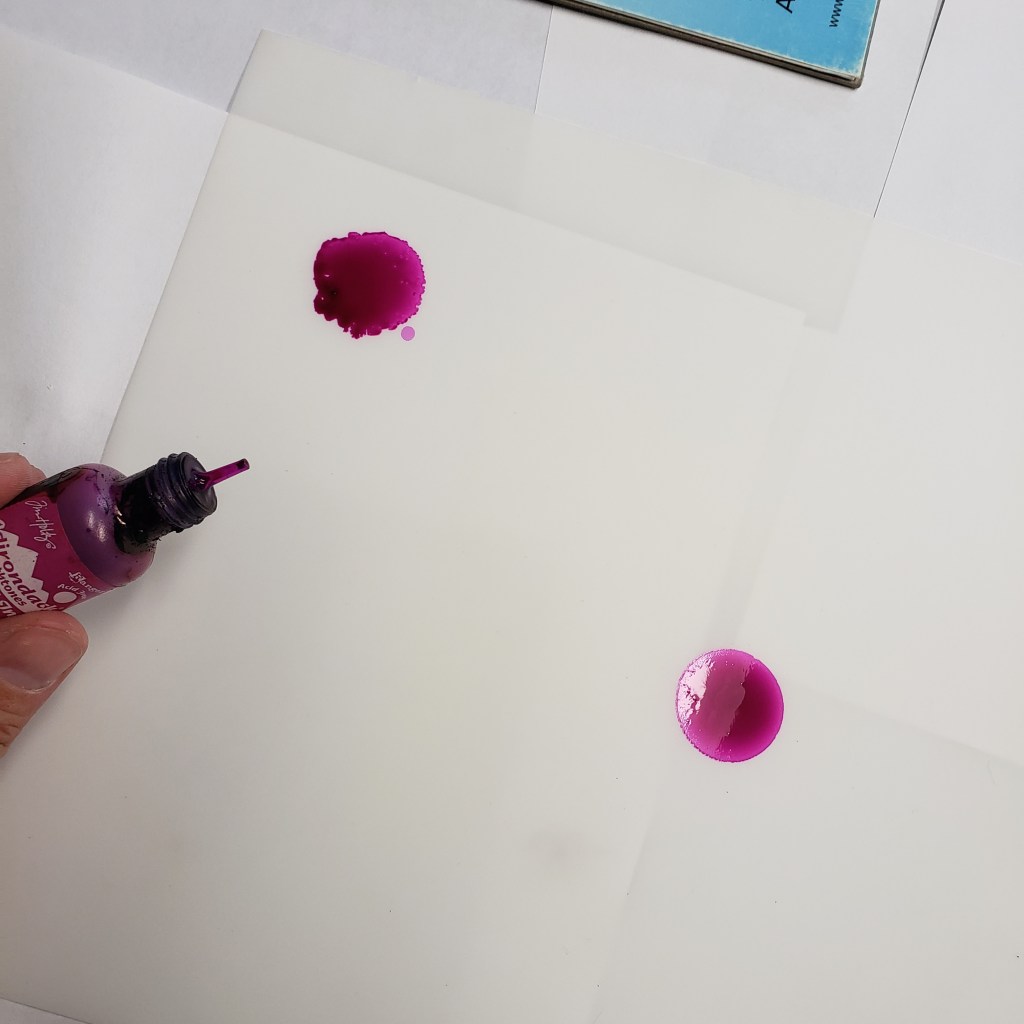
Experiment with mediums and surfaces in this project! Use alcohol inks on Yupo paper to create beautiful blooms of colors, then draw a design on top with a chalk pen! Yupo is actually polypropylene and allows the alcohol inks to sit on the surface and have fun reactions! Adding rubbing alcohol to the inks also creates more “blooming” effects!
What you need:
Yupo paper
Alcohol inks
Rubbing alchol
Paint brush
Chalk pens
Step one: Dot some colors of alcohol ink on your yupo surface!
Step two: Continue to add inks and begin to apply dots of rubbing alcohol with a paint brush – both on and around your alcohol inks.
Step three: Continue to apply inks and rubbing alcohol – I just added a section of color from corner to corner. Keep in mind, when choosing colors, your ink colors will begin to mix somewhat!
Step four: Let your ink dry completely!
Step five: Once the ink is dry, use your chalk pen to create a design on top of your ink!
Step six: Add details to your drawing – I just used a white chalk pen for the most contrast but you could use other colors as well!
Create an out of this world moon painting with acrylics on canvas! In the video below I create my sky with multiple brushes/techniques (a stencil brush, sea sponge, flat brush & paper towel) you can use all methods or choose what you have on hand to create your sky with!
What you need:
Canvas – I used an 11″x14″ stretched canvas
Acrylic Paints – I used Apple Barrel craft paints in Bright Blue, Black, White, Bright Red, Bright Yellow
Paint brushes – A 1/2″ or 3/4″ flat brush and some smaller brushes for details
Paper plate
Pencil
Paper towels
Optional: Stencil brushes and/or sea sponges
Step one: Trace a circle on your canvas – I used a plastic plate. Paint your background all black!
Step two: Begin to add clouds to your sky with other colors – I used blue, red, & white (which made pinks and purples) – see the next step for more details!
Step three: Use a firm/stiff regular flat brush, round stencil brush, sea sponge or paper towel to create a cloud texture. “Pounce” or “Dab” your paint on your canvas with any of the tools listed to create this effect. You only want a little paint on your brush/tool. Dip in multiple colors or build layers of colors on your clouds.
Step four: If you have any clouds that are too bright, you can repeat the same technique, but with black paint to help it fade in. Be careful not to mix too many colors or your clouds can end up muddy! If that happens, let your paint dry, paint it over with black, and try again!
Step five: Water down a little white acrylic paint and splatter it on your sky for stars!
Step six: Mix white and a little yellow paint to create a cream color and paint your moon!
Step seven: Mix blue and little black paint together to create a dark blue paint and make random spots on your moon. These will be the moon’s craters!
Step eight: While the dark blue spots are still a little wet, take more of your cream color and blend the edges of your spots into your moon!
Step nine: Keep blending until you’re happy with your moon! Check out the video below for more details on creating your own moon painting!
A look at some of my favorite mediums, brands, and supplies!
Pencils! I definitely enjoy working in graphite – and I think it’s one of my favorite mediums to teach as it’s a common drawing medium that almost everyone has used at some point but you can do so much with it!
While I have my favorite brands I’ve also completed pieces with just a plain #2 pencil – sometimes keeping it simple is better!
My favorite set of graphite pencils are Tombow brand MONO pencils. They’re rich, smooth and can achieve dark darks!
I also have a collection of different pencils and “accessories” that I like to use. I have my favorite mechanical pencil from an artsnacks box years ago – the Alvin Draft-Matic 0.5mm, it’s comfortable to hang onto, has a built in eraser, the lead doesn’t break easily, and just feels nice! I often use it for sketching and outlining.
The surface on which you complete your graphite drawings is just as important as the graphite itself…..check out this post for some of my favorite surfaces!
A fun little technique to create some colorful pieces of art! These also make great pieces to add to collage techniques or are fun for art journaling too!
What you need:
Watercolor paper (I use Canson XL cold press 140lb)
Masking tape
watercolor paints
Oil pastels or Crayons
Large flat brush
Step one: Tape down your watercolor paper – the tape also creates a nice border to your artwork you can decorate later! I cut my paper to be a bookmark!
Step two: Create a design or picture on your paper with your crayons or oil pastels – press firmly!
Step three: You don’t need to fill in all of your paper – leave some areas white, this will be filled in with your paint color!
Step four: Prepare your watercolor paints and gently brush overtop of your crayon or oil pastel design!
Step five: The oil pastels or crayons will resist the watercolor paint and only stick to the white areas of your paper! I used warm color crayons and cool color paint for more contrast!
Step six: Let your paint dry and remove your tape!
This piece was created with oil pastels instead of crayons!
Each month I will be spotlighting one of my students – past or present, and their artistic ventures! I work with students of all ages and abilities and you’ll get to learn a little bit about these amazing artists and their work!
Our August spotlight is on:
Ella St. Pierre
My name is Ella St. Pierre. I am 8 and a half years old and I’m going into 4th grade. I like to paint on the easel in my room, talk to my friends, go to the beach, swim, and jump on my trampoline. I also like to play board games including chess and Connect 4 and I love to play with my cat. Besides, visual arts, I like to sing and dance… and sing while dancing! I also like culinary arts. When I grow up, I want to be a surf instructor and a YouTuber.
“Party of two”, Acrylic Paint
The robot was having a party at night and no one came. He got sad, but remembered that God was at the party. This is a reminder that you can have fun even by yourself. Sometimes I look at this photo and think about the fact your never alone but with God.
How long have you been taking art lessons? “I have been taking lessons for 4 or 5 years. I started taking art lessons because my mom signed me up! But I am really glad she did. It’s really fun.”
Who or what inspires you to make your artwork? “I look around and get inspired by things I see or things that pop into my head.”
“Meteor Shower”, Remnant of my old lipstick
What are your favorite mediums or subjects for your artwork? “Pencil…. not colored pencils, but pencils, are my favorite medium. I also like puffy paint and I like to draw or paint with unusual items, like old lipstick or makeup.”
Is there a certain style, or type, of art that you’d like to someday try? “Someday, I’d like to try sculpting with clay or throwing pottery.”
“Night Sky’s”, Paint
What is your favorite color? “My favorite color is pastel yellow and pastel green.”
Is there an aspect of art you don’t like and why? “I don’t like pastels because my pastel projects end up messy. I also don’t like colored pencil because of its texture and the detail.”
“Ocean Waters”, Stamp-making
Why do you think art is important? – Why is it important for you? “The arts are fun! They are fun to learn and when I mess up, I laugh at it.”
Ella is creative and imaginative in her artwork! I’m always excited to see what she comes up with next – whether it’s her unique use of mediums, or the originality of the scenes, characters and subjects she creates within her artwork! Keep up with all the awesome artwork Ella! 🙂
Turn some of those beach treasures into a lovely trinket dish! These make great personalized gifts too!
What you need:
Clean shells – larger, smoother shells are easiest to start with!
Mod Podge – I used gloss
Paint brushes
Decorative tissue papers, or thin papers (like origami paper).
Scissors
Acrylic paints in desired colors
Metallic paints – I used Lumiere by Jacquard
Step one: Gather and clean your shells – ones that have larger, flat/smooth insides will be easiest to start with!
Step two: Find printed tissue papers, pieces of maps, origami papers, or any other thin paper to decoupage your shells with
Step three: If using tissue papers to decoupage your shell with, first paint the inside surface of your shell with acrylic paint. I used white, as my tissue paper was white with printed blue designs – this way the white parts of the tissue looks like it disappears in the back ground of my shell. You may need to apply more than one layer of paint to cover your shell with – if this is the case, let your paint dry between layers.
Step four: Cut your papers for your shells – if using tissue papers that match with the background of your shell, you don’t have to be too careful in cutting out the design precisely. If using papers that will completely cover the inside of your shell, cut it quite a bit larger than your shell!
Step five: If using tissue paper – Add Mod Podge to the inside of your shell and place your tissue paper on top
Step six: If using other papers – brush a layer of mod podge in your shell and on the back of your paper, then place in your shell
Step seven: Gently brush a layer of mod podge on top of your tissue paper or if you’re using paper follow the steps below!
Step eight: If using paper, vs. tissue paper, use your fingers to firmly press your paper into your shell…..start from the center of your shell and work out
Step nine: Use a firm brush to add a layer of mod podge on top of your paper – use the brush to help push and smooth out the paper on the shell surface! Just be careful not to tear your paper as it can become fragile!
Step ten: Let your mod podge dry and trim off any extra paper – you may also need to add in extra mod podge around the cut edges if you have some areas that are not quite stuck! Don’t worry if your cut edge is not perfect – as long as it’s glued down well, the cut edge will get covered with the metallic paints!
Step eleven: Use your metallic paints to create a painted outline on your shells!
Have fun creating these simple trinket dishes! You could also drill a hole and make them an ornament or add other elements in them like other shells, personal photos, sea glass, etc.!
Follow along to paint your own watercolor crab! My crab was created with just two colors – yellow and blue, however, you can make your crab any colors using these techniques! You can download the crab outline below and transfer it to your watercolor paper or draw your own crab outline (or outline of your choosing).
What you need:
Watercolor paper (I used Canson XL cold press 140lb)
Watercolor paints – I used Rembrandt brand in Azo Yellow Medium & Van Gogh brand in Phthalo blue
Step one: Transfer the crab outline to your watercolor paper or draw your own outline! Download the crab outline above and follow this quick tip to transfer the crab outline here.
Step two: The crab is created with a wet on wet technique – I did sections of my crab at a time, starting with the shell, I brushed on a layer of water.
Step three: Before the water dries that you applied in the last step, add blue watercolor to your shell – the paint will spread wherever the water was placed.
Step four: While your blue paint is still wet, add dabs of green or yellow paints to your crab shell and let them spread! I used a little yellow painted mixed with my blue.
Step five: While your paint is still wet, sprinkle some sea salt on it! The paint pools under the pieces of salt, when the paint dries, we’ll gently remove the salt pieces and have a unique effect left on our papers created by the salt!
Step six: Repeat steps for all the crabs legs!
Step seven: If desired, flick paint, to add some interest to your background! I used watered down blue.
Step eight: Let your paint dry – I don’t recommend speeding up with a hair dryer when the salt is involved as it can blow the salt pieces around and disrupt the textured effect!
Step nine: Once the paint is completely dry, gently rub off the salt pieces. Enjoy your crabby painting! 🙂
Ever want to transfer a drawing or printed image to another piece of paper or copy it multiple times? I typically draw my outlines on just a plain piece of printer paper and transfer onto my final drawing paper with this method….you can easily and quickly transfer your drawings this way and the transfer is also erasable!
All you need is your drawing or image you’d like to transfer (these work best on thin papers), a graphite pencil & and the canvas, paper, or surface you want to transfer your drawing to! You may also prefer to have some tape handy to help hold your paper in place.
Gather all your supplies!
Turn over the drawing, or outline you’d like transfer. Using the side of your pencil tip, shade in the back of your outline. You only have to shade where the lines you’ll be tracing on the flip side are – you can check this by flipping your paper back over and holding it up to the light (looking through your paper) to see if you’ve missed any areas with the shading.
Once you have the backside shaded in, line up your outline on the surface you’d like to transfer it to. Use tape to hold your paper in place while you trace.
Pressing firmly, trace your outline with a pencil. You can take a peek to make sure the transfer is working or to check and see if you’ve missed any lines! You can also trace your outline with a colored pencil to clearly indicate where you’ve already traced!
Once you’ve traced your outline, carefully remove the tape and your paper to reveal your copy! Since this is a graphite transfer you can also erase or lighten any lines before using your transfer in a finished project! 🙂
This is also a great method to transfer the sand dollar template for this acrylic painting!
Brighten your garden with a colorful hand painted paver! Paint just one or paint many and create a fun path through your garden!
What you need:
Cement Paver – The ones I’m using are 12″x12″
Outdoor primer
Pencil
Acrylic paint – I used Apple Barrel Craft paints in Bright Blue, Bright Yellow, Bright Red, Black, & White. You can also use Patio Paints for longer lasting results!
Krylon indoor/outdoor, gloss sealer
Step one: Prime you paver – I used an outdoor primer, brushed it on & let it dry.
Step two: Draw your design onto your paver (you can also use stencils or templates).
Step three: Begin to paint your design! I like to start with my background and work forwards.
You may need to apply more than one layer of paint with certain colors – if this is the case let layers dry between new coats!
If you want to blend colors it’s easiest to do so while the paints are still wet – brush back and forth to help blend colors!
Create effects with your paint – like splatters for stars or texture by “flicking” your paint!
Fill in your foreground with base colors…
Add your details! Leave your stepping stone as is or add in some whimsy with additional lines, colors, & patterns!
Step four: Finish your stepping stone by sealing your paint with krylon indoor/outdoor gloss sealer!
Check out the video below for more ideas or join us for a stepping stone class to create your own!
Be sure to send along a picture of your finished stepping stone! 🙂
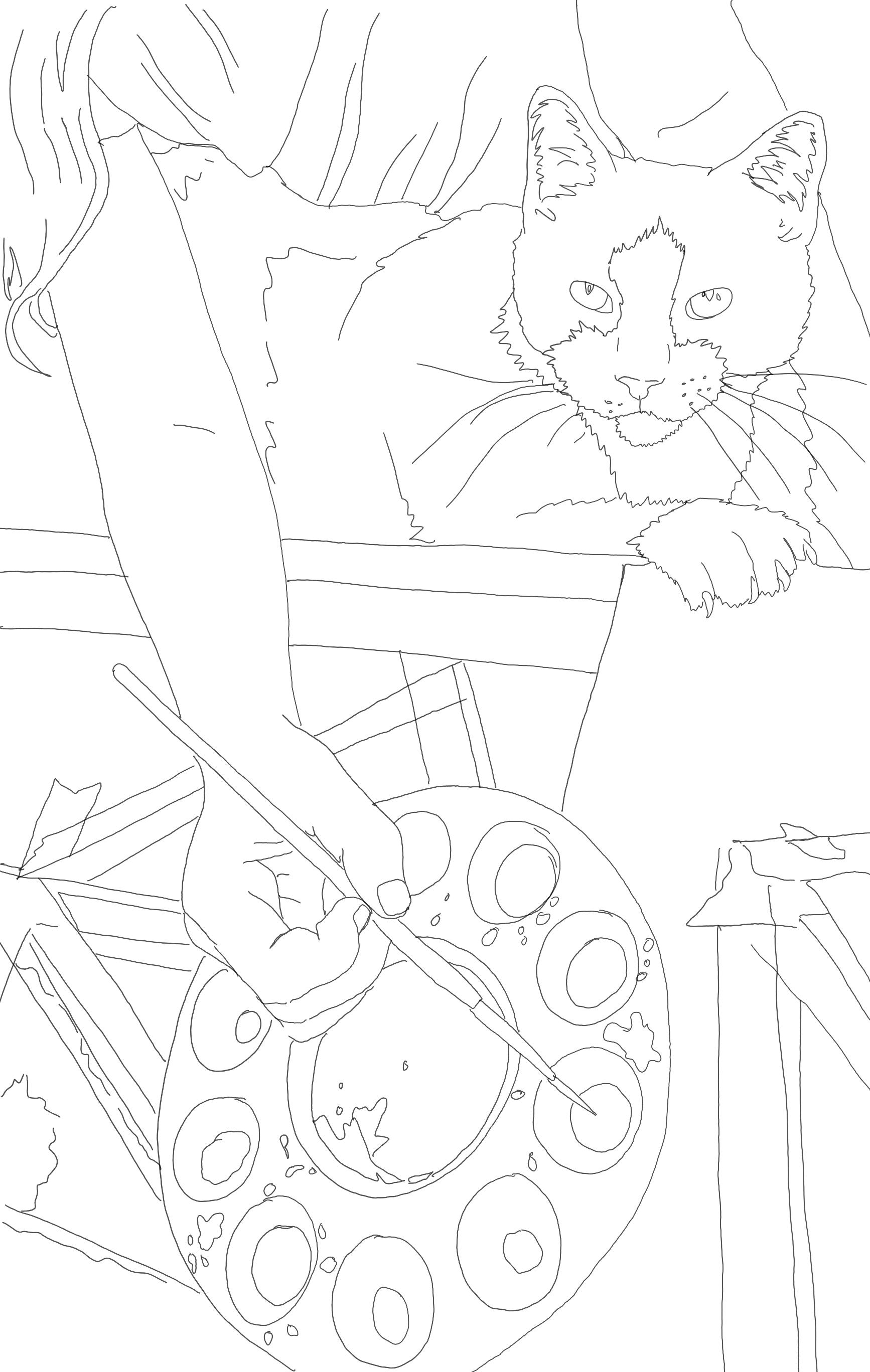
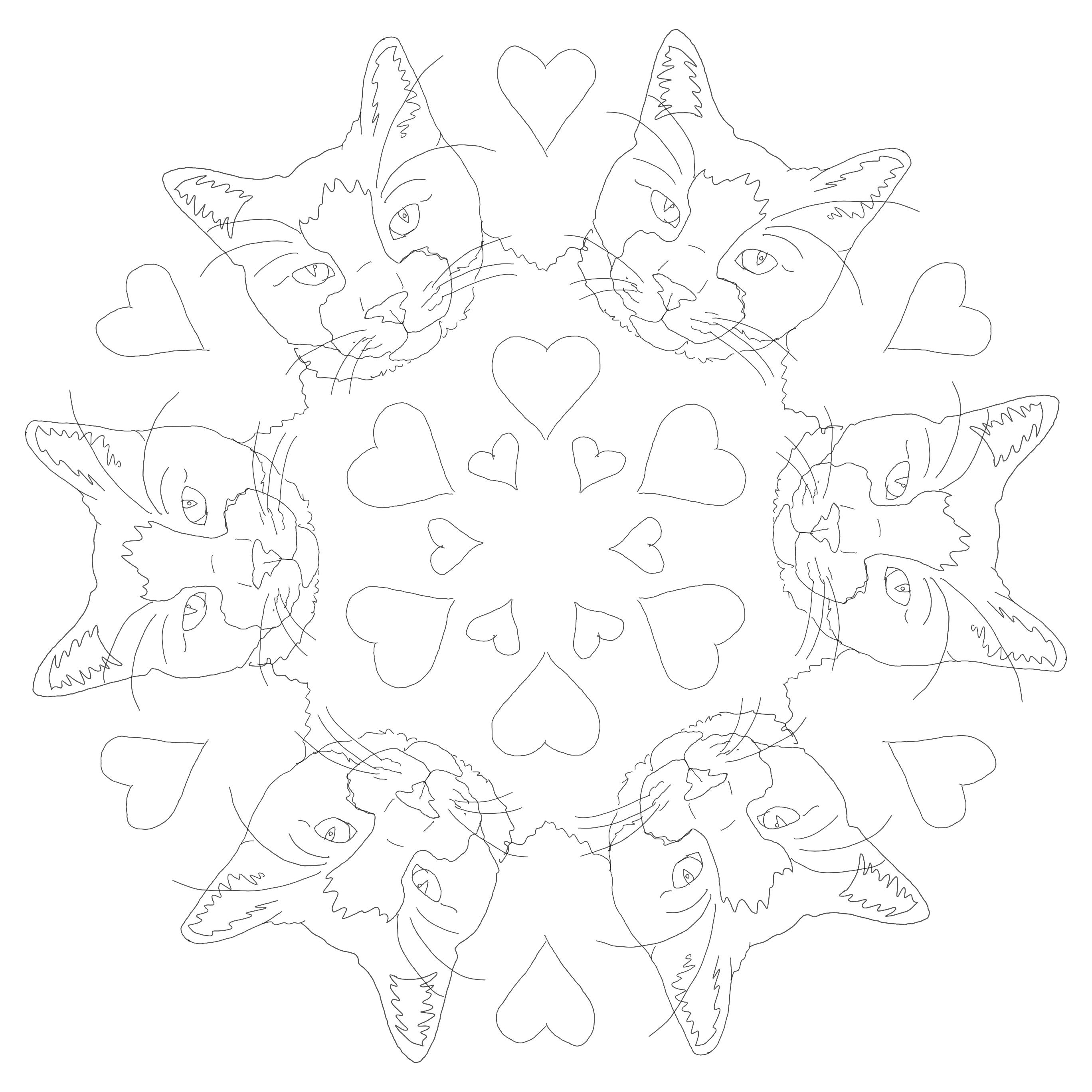
The fall schedule of classes is now available here! Tux, the art room kitty, is excited to get back to having some classes in the art room and being able to “help” out on some art projects! In celebration, enjoy some Tux coloring pages! Pages are downloadable below!
You can download all these pages below! Be sure to send me a photo of your colored in pages – I’ll add them to Tux’s fan art page! 🙂 Also check out more info on Tux here!